
Offshore Wind Farm Maintenance Services
Inspection, maintenance and repair for offshore wind assets. Share the asset location, required tasks, access arrangements and target window so we can discuss the scope, weather constraints and reporting requirements.
Offshore maintenance with defined marine interfaces
Gridinta supports component inspection, blade repair and tower maintenance within agreed offshore campaigns. A workable scope connects the technical task to transfer arrangements, turbine access, site permissions and a usable handover record. Vessel provision, marine coordination and responsibility for each interface must be agreed with the client before mobilisation.
For land-based assets, see our onshore wind turbine maintenance services. Our offshore versus onshore maintenance guide explains the planning differences.
Check Gridinta’s IRATA Full Operator membership 6036/O and published ISO 9001:2015 certificate GKLT-0480-QC when reviewing supplier documentation. These company credentials are separate from task-specific competence and any required asset authorisation.
Offshore maintenance work packages and what each delivers
Select the package by component and required decision. Inspection and repair are separate tasks unless both are explicitly included. A tower package must identify its height and accessible boundaries; splash-zone or underwater coverage should never be inferred from a general tower scope.
| Component | Inspection or repair scope | Access and marine interface | Deliverable and service |
|---|---|---|---|
| Blades | Visual or thermographic inspection; agreed composite repair and coating scope | Transfer availability, blade access, suitable work and curing conditions | Defect locations, photos/video and agreed repair record; blade repair scope |
| Tower and accessible steelwork | Weld/bolt inspection, corrosion assessment and agreed coating work | Defined accessible areas; exposure, surface condition and access restrictions | Inspection coverage, findings and completed coating or repair work; coating service |
| Gearbox and internal areas | Endoscopic inspection of accessible internal gearbox surfaces | Turbine access and stoppage; inspection openings and areas to view | Image record, coverage limits and findings; inspection scope |
| Lightning protection | LPS continuity checks at agreed points | Access to test points, isolation arrangements and manufacturer instructions | Identified test points and results against agreed criteria; LPS inspection |
Interfaces to agree before mobilisation
| Interface | Agreement required | Useful enquiry information |
|---|---|---|
| Vessel and transfer | Who provides transport and controls transfers, marine coordination and return arrangements | Planned CTV, SOV or walk-to-work arrangement; landing or gangway details |
| Weather and sea state | Applicable equipment, transfer and site limits; who authorises access or stand-down | Work window, site constraints and contingency arrangements |
| Turbine stop and isolation | Who controls stoppage, isolation and release back to operation | Asset procedures and permitted work periods |
| Permits and simultaneous operations | Who issues permits and coordinates other teams working nearby | Permit process, overlapping activities and rescue arrangements |
| Personnel documents | Project-specific competence, training and medical acceptance requirements | Client requirements and document review process |
| Handover | Report format, criteria, review responsibility and treatment of unfinished work | Template, defect coding and acceptance requirements |
The G+ good practice guidance addresses vessel management, coordination and offshore transfer responsibilities. Project arrangements still need to be agreed for the actual site. Compare CTV, SOV and walk-to-work interfaces and our offshore campaign planning guide.
How an offshore campaign runs
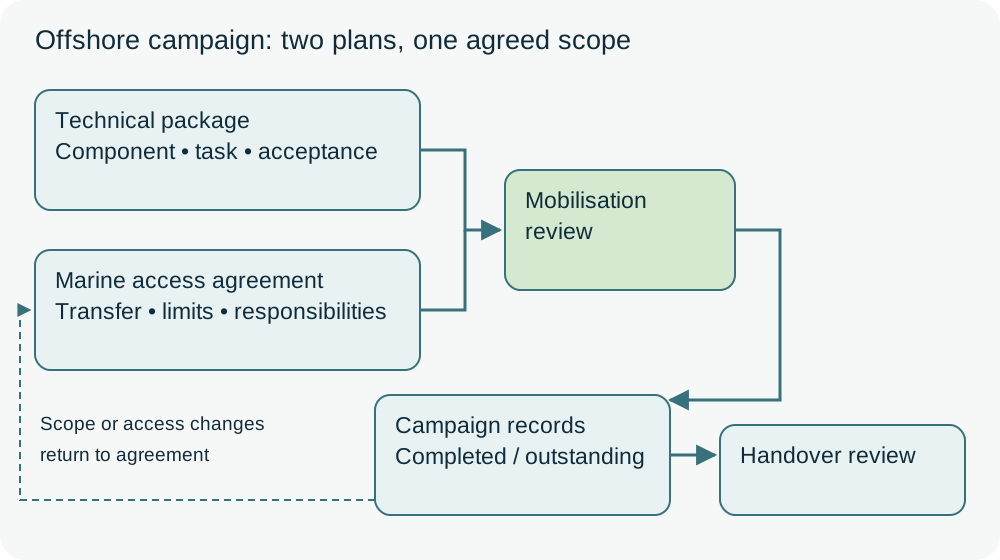
Planning brings the technical work package and the marine access plan together. Mobilisation follows confirmation of those interfaces. During campaign days, progress records distinguish completed tasks, new findings and weather or access losses. At demobilisation and handover, outstanding items remain visible so the operator can decide on a return visit or further engineering review.
Access capability and scope confirmation
Rope access or suspended platforms are selected against the task, turbine model, equipment documentation and site rules. Platform suitability, weather limits and rescue arrangements must be assessed for the project. See our industrial rope access services and inspection service for the technical scope.
Send the site, turbine model, component and defect list, available reports, intended work window, marine access arrangement and report template. Confirm which parties supply vessels, permits, isolation and acceptance review so the quotation covers a defined campaign package.