
Comparing Corrosion Under Insulation Inspection Methods and Their Limits
Corrosion under insulation (CUI) inspection needs three separate answers: where conditions favour corrosion, where a screening method identifies a possible defect, and where examination confirms the metal condition. This framing is adapted from Tai and Sohel’s 2026 review of the screening–confirmation gap in CUI inspection. Wet insulation is a risk indicator; a screening signal is a reason to investigate; a verified wall-thickness map can support an engineering assessment. Treating all three as “corrosion detected” leads to poorly targeted openings and unsupported decisions about continued operation.
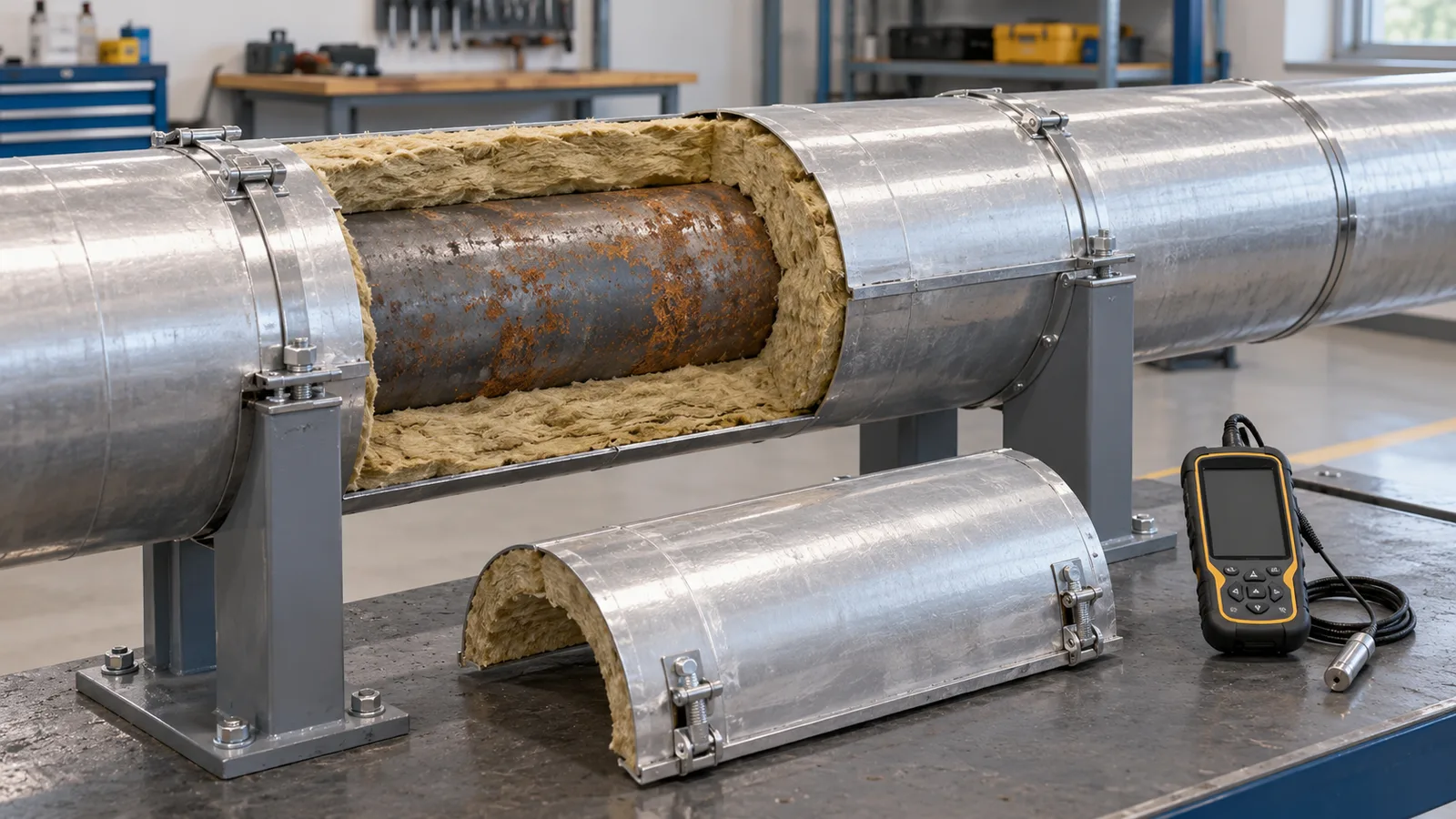
For an owner or inspection planner, the useful deliverable is a traceable route from asset identification to an agreed action. Specify the suspected damage mechanism, coverage, method limits and confirmation plan before choosing equipment. Gridinta’s NDT inspection service is a starting point for discussing an inspection scope.
Start with the inspection decision
An inspection intended to prioritise insulation removal has a different evidence requirement from one used to assess remaining wall thickness. Ask which decision the report must support: select locations for opening, assess an exposed area, define a repair boundary or provide measurements for an integrity engineer. Record who owns that decision and what information that person needs. A coloured screening map alone should not silently become a fitness-for-service conclusion.
HOIS-G-023, the HOIS guidance for in-situ inspection of CUI, compares the strengths, limitations and applications of CUI inspection methods. The current Issue 3 (January 2023) is free from BINDT; the openly downloadable Issue 2 (January 2021) explains that moisture detectors indicate only the integrity of the weather shield, while metal-loss methods detect CUI only once significant material has been lost. Check which issue a work specification cites.
Scroll horizontally to see all table columns.
| Evidence | What it can support | What must remain explicit |
|---|---|---|
| Risk indication | Prioritising locations with damaged cladding, moisture or a thermal anomaly. | Neither corrosion depth nor the absence of historical damage is established. |
| Screening indication | Locating an area for a defined follow-up examination. | The tested volume, sensitivity, blind areas and interpretation confidence. |
| Local confirmation | Recording the exposed condition and qualified thickness or other relevant measurements. | The actual extent examined and the limits of extrapolation beyond it. |
Build an asset-specific inspection pack
Bring together line or vessel identification, material, diameter, nominal thickness, insulation and cladding construction, coating history, operating conditions and previous inspection findings. Include changes in duty, shutdowns and known water ingress rather than relying only on today’s operating temperature. Mark supports, penetrations, transitions and inaccessible areas on an isometric or location drawing. The planner should be able to connect every proposed measurement to a recognisable place on the asset.
Choose the examination for the damage mechanism as well as the access problem. Carbon-steel wall loss and cracking concerns in stainless equipment are different questions; a wall-loss screening scope does not automatically address cracking. Temperature ranges and inspection intervals must be set for the asset using the owner’s corrosion assessment, applicable requirements and actual service history. If essential asset data is missing, show the uncertainty in the work pack.
What the main techniques can and cannot tell you
Issue 2 of the HOIS guidance also explains why “without stripping all insulation” should not be read as “without any access preparation”. Pulsed eddy current (PEC) measures remaining wall thickness averaged over the sensor footprint, which is larger than the insulation thickness, so smaller-scale pitting may be missed or undersized; ferromagnetic cladding such as galvanised steel reduces its effectiveness. For guided wave testing (GWT), insulation is removed along a short section so that the transducer ring contacts the pipe around its entire circumference. From there, GWT can screen up to about 100 m in each direction in favourable conditions, but bonded coatings such as bitumastic can cut the range to a few metres, and it detects loss of cross-sectional area (about 5% in inspection mode), so circumferentially localised damage can fall below its threshold. Technique selection still needs a qualified procedure and demonstration appropriate to the asset.
Scroll horizontally to see all table columns.
| Method | Useful role | Limitation to resolve |
|---|---|---|
| External visual survey / thermography | Find damaged weatherproofing or thermal patterns that justify investigation. | A dry or visually sound area is not proof of sound metal. |
| Pulsed eddy current (PEC) | Screen suitable ferromagnetic assets for wall loss through insulation. | A sensor footprint averages the response; small deep pits may be understated or missed. |
| Guided wave testing (GWT) | Screen along a pipe from a local transducer position. | Reliable range, geometric reflections and local sensitivity must be reported. |
| Radiography | Obtain a projection of selected pipe regions through insulation. | Geometry, overlapping features, sizing suitability and radiation controls affect the scope. |
| Opening plus direct examination / UT | Inspect exposed surfaces and measure selected locations or mapped areas. | Surface preparation, scan coverage and sampling determine what the result represents. |
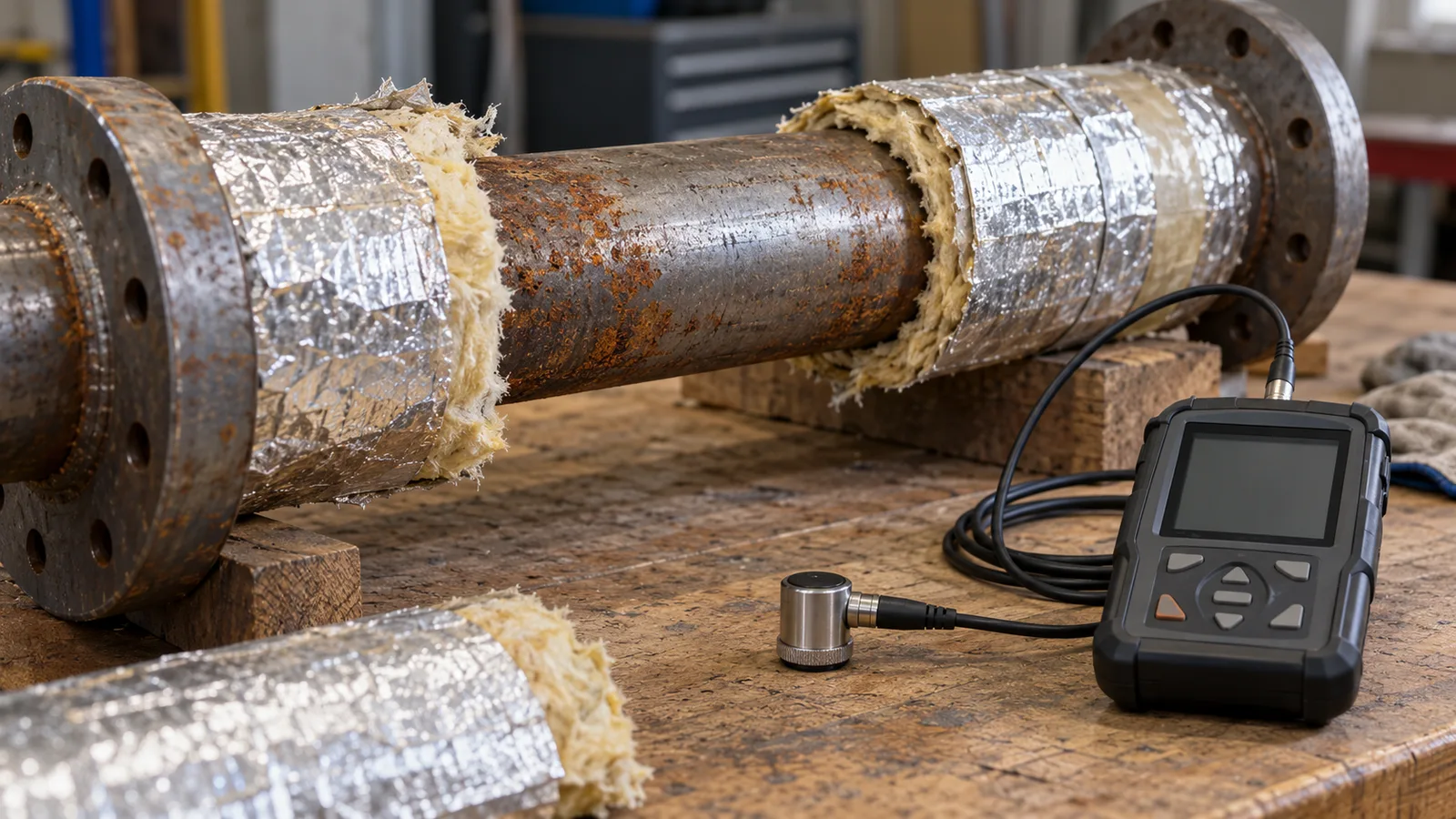
TWI’s guided-wave explanation notes that reliable test distance depends on propagation conditions and that signal-to-noise affects interpretation. A supplier should therefore state achieved coverage and excluded zones, rather than offer only a nominal metres-per-test figure. For broader distinctions between an access method and an NDT method, see our guide to rope access NDT methods and limits.
Plan confirmation before the screening campaign
Agree how indications will be relocated, opened and checked while the screening team is still available to explain its findings. Use permanent asset references and orientation, not just an unlabelled photograph. Define who may authorise insulation removal, how the process condition will be made suitable for the work and how suspected severe damage will be escalated. Removing insulation from a potentially weakened live system is itself a planned activity, not an automatic next step.
For each opening, record what was actually exposed, the coating condition, corrosion morphology and measurement grid or scan area. Distinguish a lowest measured value from the unknown minimum across an unexamined region. If the observed damage extends to the opening edge, ask the responsible engineer whether more exposure is required. Reinstatement should address the coating, insulation and weather sealing; closing a hole without resolving the water path can leave the original deterioration mechanism in place.
A practical report acceptance checklist
- Every observation has an asset ID, reproducible position and date, with operating and examination conditions recorded.
- Risk indicators, screening indications and confirmed findings use separate labels and conclusions.
- Method, procedure, equipment, calibration or checks, personnel competence and analysis responsibilities are identifiable.
- Coverage drawings show untested sections and areas where sensitivity was reduced, including access limitations.
- Screening findings have a defined confirmation or engineering-review action, responsible person and priority.
- Measurements retain their location, units, coverage and uncertainty; engineering acceptance criteria are identified separately.
- Insulation and weatherproofing reinstatement, unresolved conditions and the next review are documented.
The same 2026 review by Tai and Sohel argues for linking each indication to verified evidence and an engineering decision. Its discussion is useful context, not validation of a particular product on your asset. Ask for comparable field evidence and clearly stated limits whenever a proposal relies on a new sensor, automated interpretation or a claimed reduction in insulation removal.
For an insulated storage tank, agree the concealed-shell scope separately from external tank inspection by rope access.
Common questions about CUI inspection methods
Does wet insulation prove corrosion?
Can PEC provide the deepest pit thickness?
How much insulation has to be removed for guided wave testing?
Does metal cladding affect pulsed eddy current inspection?
Does a clear screening result mean the whole line is safe?
Who decides whether to repair or continue operating?
Sources
Sources checked on 25 October 2026: HOIS-G-023 Issue 3 at BINDT; HOIS-G-023 Issue 2 (PDF); TWI on guided wave ultrasonic testing; Tai and Sohel, Corrosion and Materials Degradation, 2026, 7(4), 70.