
ISO 12944 Corrosivity Categories From C1 to CX, Explained for Steel Owners
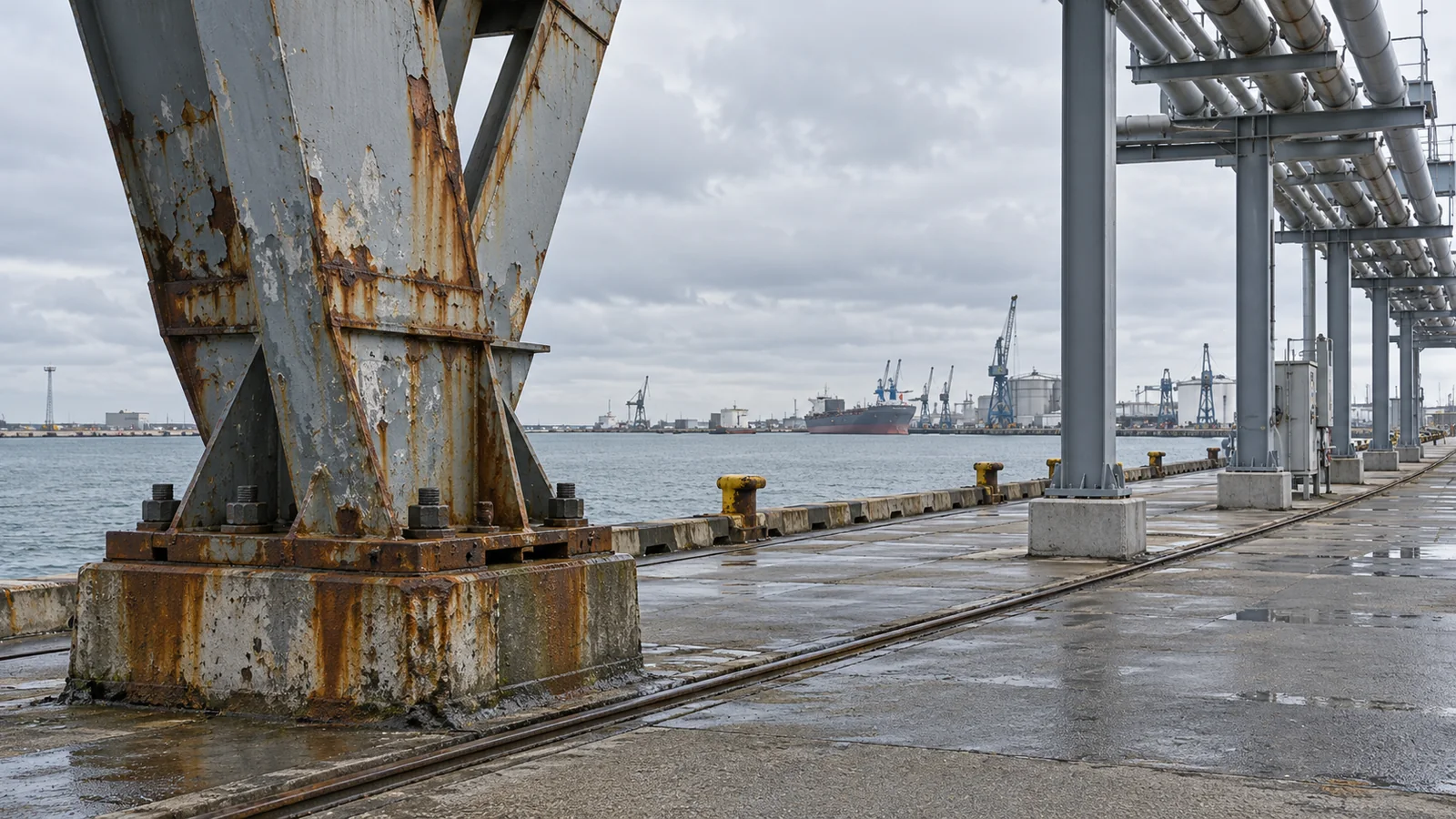
ISO 12944 sorts the environment around a steel structure into six atmospheric corrosivity categories, from C1 (very low) to CX (extreme), and four immersion categories, Im1 to Im4. The category, together with the durability you want before the first major maintenance, decides which paint system, surface preparation and inspection regime fit the job. Most coastal and industrial assets around the Baltic fall somewhere between C3 and C5, and offshore steel is designed for CX and Im4.
What ISO 12944 covers, part by part
ISO 12944 is the international standard for corrosion protection of steel structures by protective paint systems. It has nine parts, most revised in 2017 and 2018.
- Part 1 (2017): general introduction, scope and the four durability ranges.
- Part 2 (2017): classification of environments into C and Im categories.
- Part 3 (2017): design considerations.
- Part 4 (2017): types of surface and surface preparation.
- Part 5 (2019): protective paint systems, with selection tables by category and durability.
- Part 6 (2018): laboratory performance test methods.
- Part 7 (2017): execution and supervision of paint work.
- Part 8 (2017): specifications for new work and maintenance.
- Part 9 (2018): paint systems and test methods for offshore and related structures.
According to the SIS listing for ISO 12944-5:2019, the current Part 5 replaced the 2018 edition and its selection guidance excludes CX and Im4. Those two harshest categories are handled by Part 9. As of October 2026, ISO committee drafts for revised Parts 2 and 5 are in preparation, so always check which edition a specification cites.
Atmospheric corrosivity categories C1 to CX
Each atmospheric corrosivity category is defined by how much metal a standard specimen loses in its first year of exposure. ISO 12944-2 takes these bands from ISO 9223. For low-carbon steel, the same bands are also given as mass loss, for example more than 200 up to 400 g/m² in the first year for C3.
| Category | Corrosivity | Low-carbon steel, µm | Zinc, µm per year | Typical exterior example |
|---|---|---|---|---|
| C1 | Very low | up to 1.3 | up to 0.1 | None; heated clean interiors only |
| C2 | Low | 1.3 to 25 | 0.1 to 0.7 | Rural areas with low pollution |
| C3 | Medium | 25 to 50 | 0.7 to 2.1 | Urban and industrial air, low-salinity coast |
| C4 | High | 50 to 80 | 2.1 to 4.2 | Industrial areas, moderately saline coast |
| C5 | Very high | 80 to 200 | 4.2 to 8.4 | Humid aggressive industry, highly saline coast |
| CX | Extreme | 200 to 700 | 8.4 to 25 | Saline offshore, extreme humid industry, tropics |
The steel figures and environment examples follow the table reproduced on SteelConstruction.info's corrosion protection page, which stresses that the examples are informative only. The zinc rates come from the American Galvanizers Association summary of ISO 9223 categories.
Older specifications often mention C5-I (industrial) and C5-M (marine) from the 1998 edition. The 2017 edition merged them into a single C5 and added CX for the most severe offshore and industrial conditions.
Immersion categories Im1 to Im4 and the splash zone
Steel in water or soil is classified separately, because the coating stays wet.
- Im1: fresh water, such as river installations and hydroelectric plants.
- Im2: sea or brackish water without cathodic protection, such as harbour walls, locks and sluice gates.
- Im3: soil, such as buried tanks, steel piles and pipes.
- Im4: sea or brackish water with cathodic protection, typically offshore foundations.
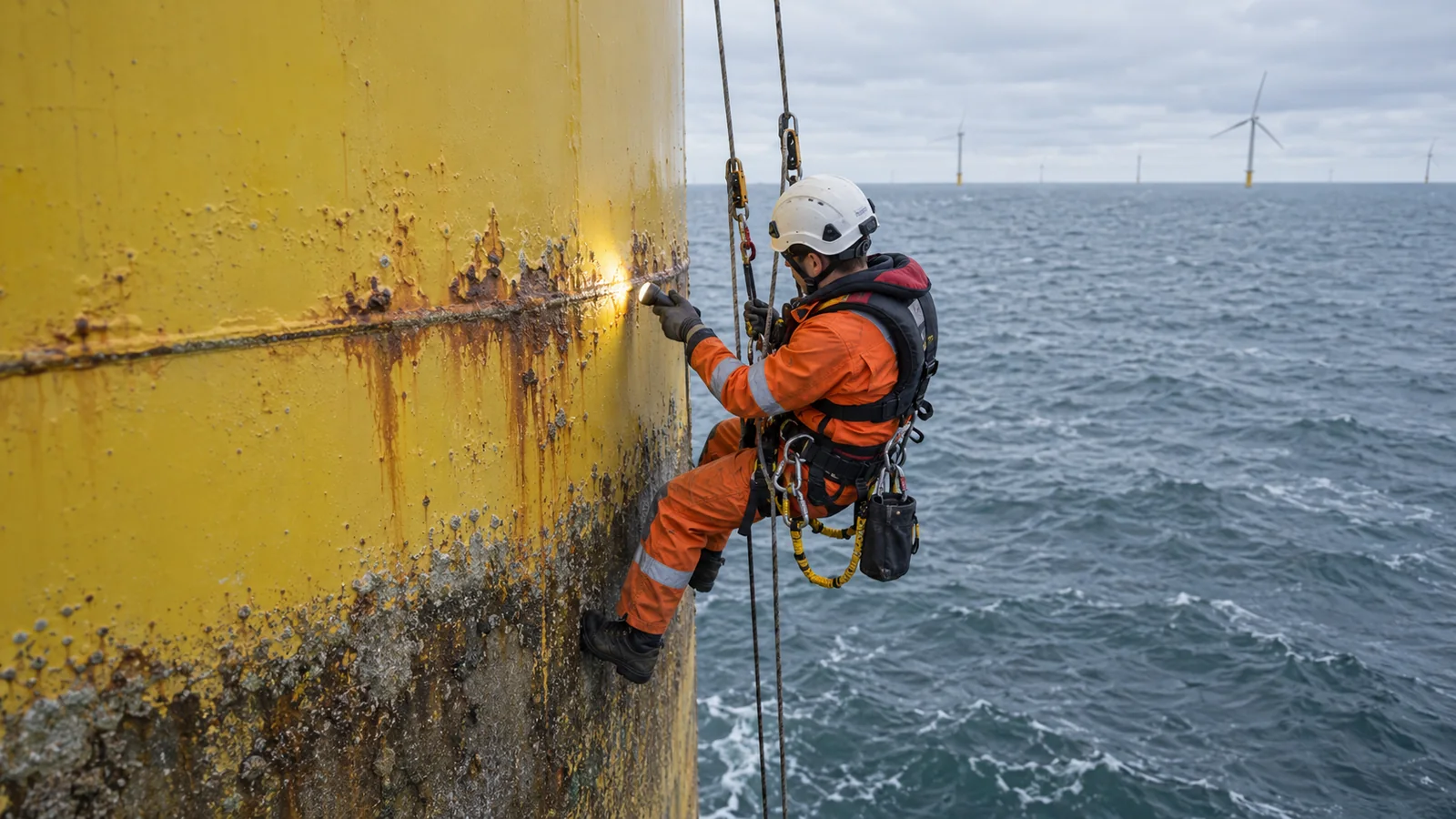
The splash zone between air and water is usually the hardest place to protect. Our article on splash zone corrosion on offshore wind turbines explains why that band corrodes faster than the steel above or below it.
Durability ranges are a planning figure, not a warranty
ISO 12944-1:2017 defines four durability ranges, measured as the time to the first major maintenance painting:
- Low (L): up to 7 years.
- Medium (M): 7 to 15 years.
- High (H): 15 to 25 years.
- Very high (VH): more than 25 years.
The very high range was new in 2017. Coating suppliers' ISO 12944:2017 systems guides and the standard itself make the same point: durability is a technical planning parameter for maintenance budgets, not a guarantee time. A guarantee is a separate contractual matter.
How to determine the corrosivity category for your site
The common route is to compare the site with the environment descriptions in ISO 12944-2. The more accurate one is to expose standard steel and zinc coupons for a year and measure the loss, using the methods in ISO 9226, then classify the result under ISO 9223.
Look at the microclimate as well as the region. A C3 inland site can still have C5 conditions locally.
- Splash and spray from the sea, cooling towers or wash-down.
- Surfaces that stay wet, such as tank roofs, crevices and the shaded side of a structure.
- Chemical exposure in process plants and near stacks.
- De-icing salts on bridges, ramps and roads.
- Interior spaces with frequent condensation.
What this means on the Baltic coast
The Baltic Sea is brackish. HELCOM gives surface salinity of about 20 PSU in the Kattegat, falling to 1 to 2 PSU in the northern Bothnian Bay, against about 35 PSU in the open ocean. Lower salinity still leaves wind-blown spray, long wet periods, freeze-thaw cycles and industrial emissions.
As a typical planning assumption, steel in harbour and industrial zones such as Klaipėda port is often designed for C4 or C5, and offshore steel for CX in the atmosphere and Im4 below the waterline. Confirm them by site assessment or coupon data.
Choosing protection for each corrosivity category
| Environment | Common approach | Standard to reference |
|---|---|---|
| C2 to C3 | Paint system or hot-dip galvanizing alone | ISO 12944-5, ISO 1461 |
| C4 to C5 | Multi-coat paint system or duplex (galvanizing plus paint) | ISO 12944-5, ISO 1461 |
| CX and Im4 | Pre-qualified offshore system with cathodic protection below water | ISO 12944-9, NORSOK M-501 |
| Im1 to Im3 | Immersion-grade system, often with cathodic protection | ISO 12944-5 |
Paint systems in ISO 12944-5 are listed by binder, number of coats and nominal dry film thickness for each category and durability. ISO 12944-6:2018 then sets the laboratory tests that a system must pass for its category and durability, and paint suppliers publish which of their systems have passed them.
Hot-dip galvanizing to ISO 1461:2022 gives a zinc layer that corrodes slowly and predictably. In a duplex system the paint protects the zinc and the zinc protects the steel at damage, so the pair usually outlasts either layer alone. EN 15773:2018 covers the powder-coated version of a duplex system.
For offshore and related structures, ISO 12944-9:2018 covers CX and Im4 and replaced ISO 20340:2009. The oil and gas sector on the Norwegian shelf also applies NORSOK M-501:2022, which sets requirements for coating selection, surface preparation, application and inspection. See also how protective coatings protect offshore infrastructure.
Inspection and quality control during coating work
Most premature coating failures trace back to preparation, contamination or film thickness, as explained in our article on what makes industrial coating fail. The checks below are routine on ISO 12944 work.
- Surface cleanliness: blast grade to ISO 8501-1, typically Sa 2½ for C4 and above.
- Soluble salts: sampling to ISO 8502-6 and conductivity measurement to ISO 8502-9.
- Climate: steel temperature at least 3 °C above the dew point, checked as described in ISO 8502-4.
- Dry film thickness: measured on blasted steel to ISO 19840.
- Adhesion: pull-off testing to ISO 4624, assessed under ISO 16276-1, or cross-cut and X-cut tests under ISO 16276-2.
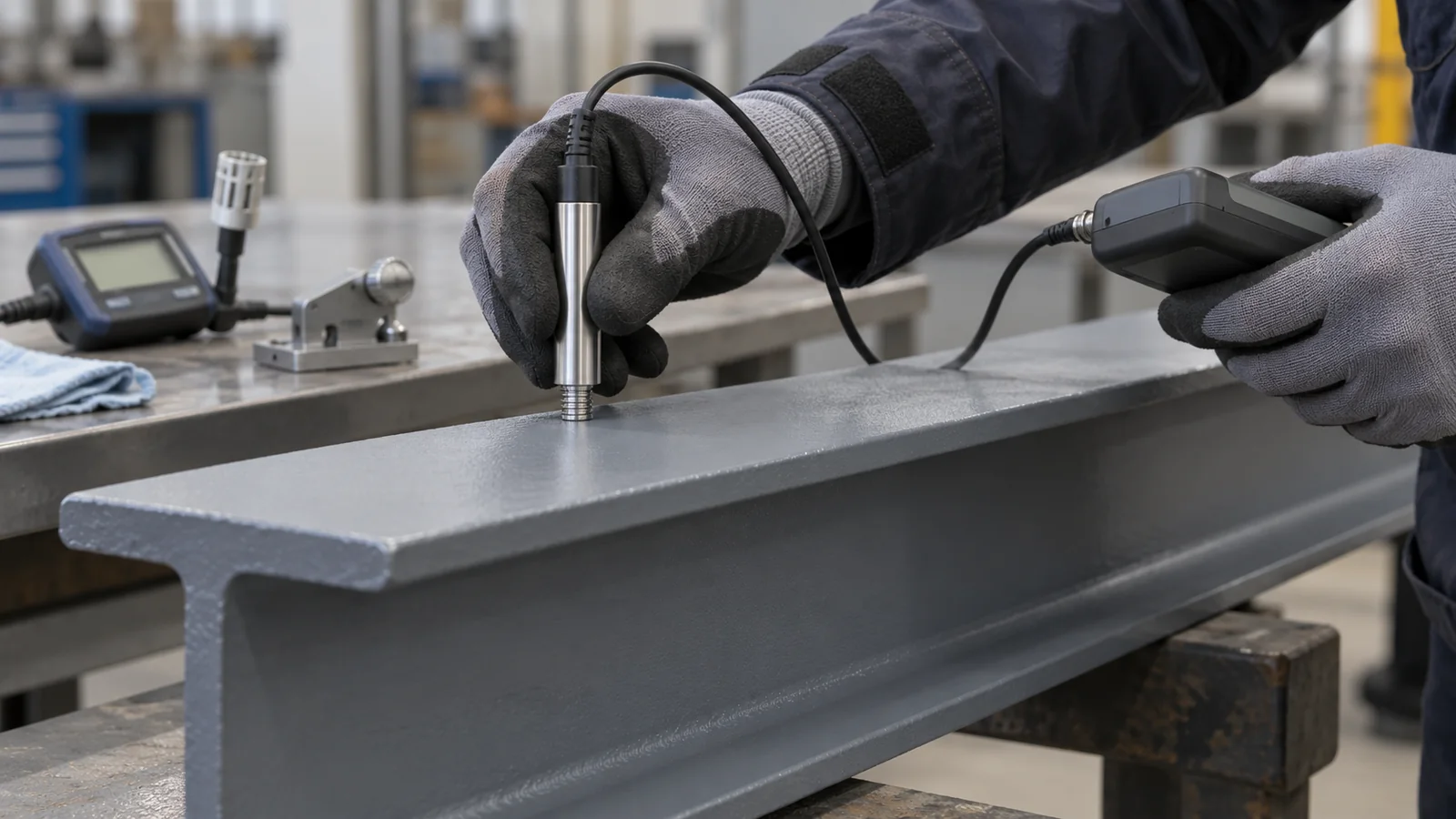
Our industrial steel coating inspection checklist sets out these hold points in order. At Gridinta we combine NDT and steel coating inspection with painting services at height, so touch-up and maintenance painting on towers, tanks and stacks can be done by rope access without full scaffolding.
What to check before you specify or tender coating work
- Agree the corrosivity category for each zone of the structure.
- Choose a durability range that matches the planned maintenance interval and access cost.
- Name the governing edition of ISO 12944, and ISO 12944-9 or NORSOK M-501 where offshore.
- Specify surface preparation grade, salt limit, dew point margin and DFT acceptance criteria.
- Ask for proof that the paint system passed the matching ISO 12944-6 or ISO 12944-9 tests.
- Plan inspection hold points and records before work starts.
- Budget access for future touch-up at height and in the splash zone.