
What Do a Welding Procedure Specification (WPS), WPQR and Welder Certificate Each Prove?
A welding procedure specification (WPS) describes the welding procedure to use; a welding procedure qualification record (WPQR) records the qualification evidence for a procedure; a welder qualification concerns the person performing the weld. For procurement of industrial welding and fitting work, request all applicable evidence and check how it relates to the actual joint, materials, process and project specification. One document does not automatically substitute for another.
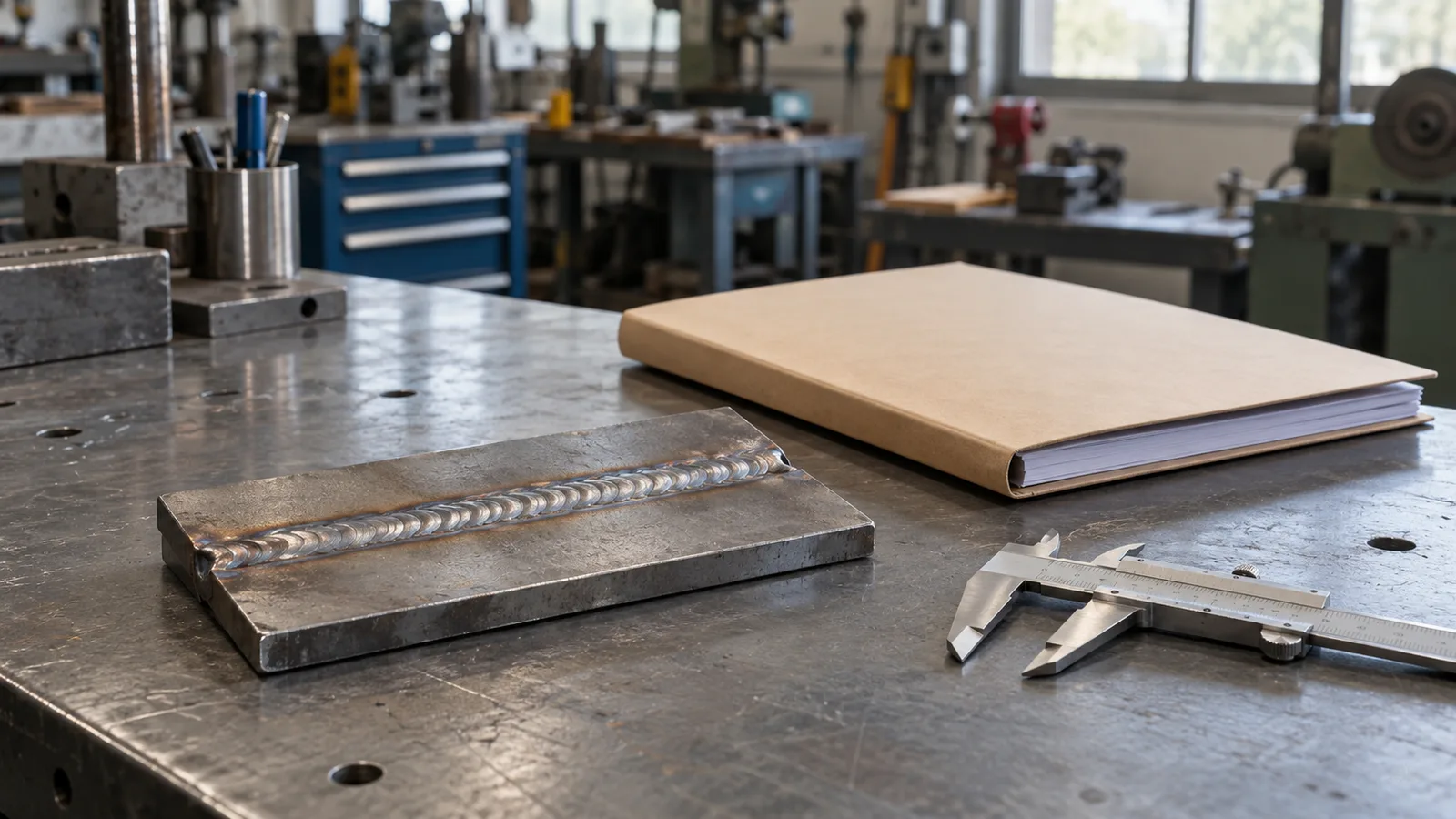
Three documents, three different questions
Scroll horizontally to see all table columns.
| Document | Main question | Useful review check |
|---|---|---|
| Welding Procedure Specification (WPS) | What procedure is intended for production? | Identify the document number, revision, joint application and applicable instructions. |
| Welding Procedure Qualification Record (WPQR) | What evidence supports the qualified procedure? | Trace the WPS to its qualification basis, recorded test conditions and results. |
| Welder qualification certificate | Is this named person qualified for the assigned welding? | Compare identity, qualification range and maintained validity with the proposed work. |
ISO 15609-1:2019 specifies the content of an arc-welding WPS. ISO 15614-1:2017 describes qualification through welding procedure tests for its defined materials and processes. ISO 9606-1:2012 addresses qualification testing of welders for fusion welding of steels. Their different subjects explain why a file labelled “welding certificates” is not yet a complete answer to a procurement enquiry.
A WPQR normally connects the test welding record with inspection and test evidence; a WPS is the controlled production document. TWI’s explanation of procedure qualification describes this evidence chain. Treat the table above as a review framework, not a template for issuing welding documents.
Confirm the edition before comparing certificates
On 25 October 2026, ISO’s catalogue listed ISO 15609-1:2019 as current following confirmation in 2025. It also listed ISO 15614-1:2017 as current, with one amendment and a successor at FDIS stage, while ISO 9606-1:2012 remained published with a revision in development. A draft designation is not a published replacement. Recheck the catalogue when placing the order.
Record the contract’s full standard references, applicable amendments, national or European adoption where specified, and the edition the client accepts. Do not silently replace an older contractual reference with a newer catalogue entry, or reject an existing qualification solely because a newer publication is anticipated. Ask the responsible welding specialist to resolve the acceptance basis in writing. This is especially useful where drawings, purchase orders and supplier submissions were produced at different times.
Start with the weld schedule
A useful first request is a matrix connecting each weld or weld family to the proposed WPS, supporting qualification basis and assigned personnel. Include the drawing revision and joint identifier so that everyone is reviewing the same work. If a supplier submits a large certificate folder without this mapping, ask for an index before trying to infer coverage from individual PDFs.
For example, suppose an enquiry concerns replacement steel pipework but the supplier sends a procedure used on plate fabrication. The difference is a question for review, not automatic proof of acceptance or rejection. Ask the welding coordinator to show how the proposed joint falls within the relevant qualified ranges. Demonstrating those ranges is the welding coordinator’s task, not a calculation for the procurement reviewer.
A practical document-review checklist
- Scope and identity: match the manufacturer, project, component and document references. Confirm who controls the production procedure and who is responsible for accepting the submission.
- WPS revision: request the issue intended for the job. Ask the reviewer to compare the proposed materials, joint, dimensions, process and position with its stated application.
- Qualification link: identify the WPQR or other permitted qualification basis behind the WPS. Ask for referenced test reports and the relevant qualified ranges, not only a signed cover sheet.
- Personnel coverage: list the people proposed for each welding duty and have their qualification ranges checked against that duty. Distinguish a test date from evidence that validity has been maintained.
- Inspection agreement: establish the inspection plan, acceptance criteria, reporting responsibilities and any hold or witness points before work begins.
- Close outstanding questions: record each missing item, the responsible reviewer and the decision needed. Retain the final accepted revision rather than several conflicting email attachments.
Numerical qualification ranges, and whether a particular qualification is acceptable, are decided from the applicable standards, complete records and competent technical review. The practical purpose of the checklist is to make the supplier’s evidence easy to trace and the client’s unresolved questions explicit.
Validity needs more than a date
TWI Job Knowledge 39 explains how a welder qualification to BS EN ISO 9606 is kept valid. The employer, welding coordinator, examiner or examining body can confirm it at six-monthly intervals, provided the welder has been welding successfully within the range of qualification on the certificate. Revalidation then follows one of three routes:
- Route a: the welder is retested every three years.
- Route b: every two years, two welds made during the last six months of the validity period are tested by radiographic, ultrasonic or destructive testing, and the results are recorded.
- Route c: the qualification remains valid while it is confirmed as above, provided the welder works for the same manufacturer for whom they qualified, that manufacturer’s quality programme has been verified to ISO 3834-2 or ISO 3834-3, and the manufacturer has documented that the welder produces welds of acceptable quality.
Ask which route the certificate uses and request the supporting evidence. Avoid writing “all welding certificates last two years” into a tender: it merges different documents and ignores their conditions.
An unclear continuity entry should become a specific query: who confirmed it, for which period and on what evidence? Equally, a recent test date does not show that its range matches the work. Keep the questions of identity, scope and maintained validity separate in the review log so that a clear answer to one does not hide a gap in another.
Procedure ownership also matters. TWI’s guidance on using another company’s qualified procedures explains that acceptance depends on the contract and applicable codes. Do not assume that acquiring a copy of a WPQR transfers the right to use it. Ask the manufacturer to identify the permitted basis and have the responsible reviewer confirm its application.
Qualifications are not the completed weld record
A coherent pre-work document package still needs production traceability and the agreed inspection evidence at handover. The separate guide to weld defects, inspection and reporting explains why findings must be evaluated against agreed criteria. Keep that acceptance decision connected to the weld identifier, rather than treating the existence of a WPS as proof that every production weld passed inspection.
For a project enquiry, the welding and fitting service and weld NDT and inspection service provide relevant starting points. Send drawings, materials, location, intended work and the contract requirements. The specific procedures, personnel evidence and review responsibilities are agreed for each assignment.
WPS, WPQR and welder qualification questions
Is a WPS a welder certificate?
Does every WPS need its own new procedure test?
How is a welder qualification kept valid under ISO 9606-1?
Do all welding certificates last two years?
Can one WPQR cover every welding job?
Can satisfactory NDT replace missing qualification documents?
Sources
Sources checked on 25 October 2026: ISO 15609-1, ISO 15614-1, ISO 9606-1, TWI Job Knowledge 39: welding procedure, TWI: procedure use across companies, and TWI: procedure qualification evidence.