
How Much Does Wind Turbine Maintenance Cost per Year, and What Drives the Bill?

Recent benchmarks put the total annual operating cost of a modern European onshore turbine at about USD 40,000 to 53,000 per MW (IRENA, 2024 dollars) or €49,000 to €57,000 per MW (Deutsche WindGuard, Germany). The wind turbine maintenance cost inside that figure (service, repairs and inspections) is about €13,000 to €17,000 per MW. For a 5 MW turbine at German levels, that is roughly €245,000 to €285,000 a year in total, by our calculation. Costs rise in the second decade, and offshore costs about twice as much per MW.
Wind turbine maintenance cost benchmarks from public sources
Few owners publish their bills, so the best public numbers come from surveys and cost models. Each measures something different, so the table states scope, year and currency.
| Source and edition | Scope | Annual figure | Per MW per year |
|---|---|---|---|
| Deutsche WindGuard 2024, Germany | All operating costs, years 1-10 | 49 €/kW (nominal) | €49,000 |
| Deutsche WindGuard 2024, Germany | All operating costs, years 11-20 | 57 €/kW (nominal) | €57,000 |
| IRENA 2024 cost report | O&M assumption, Denmark to Germany | USD 40-53/kW (2024 USD) | USD 40,000-53,000 |
| NREL 2024 Edition, US | Reference plant OpEx, 3.3 MW turbines | USD 43/kW (2023 USD) | USD 43,000 |
| Danish Energy Agency | Fixed O&M only, 2025 estimate | €17,400/MW (2020 EUR) | €17,400 plus about €2/MWh |
| BNEF via IRENA, 2024 | Full-service contract, 6 MW+ turbines | USD 14.4/kW | USD 14,400 |
The Deutsche WindGuard report for the German economy ministry, dated October 2024, surveyed 58 projects totalling 1,213 MW commissioned in 2024 to 2026. IRENA's Renewable Power Generation Costs in 2024, published in July 2025, uses USD 40/kW/year for Denmark, USD 45 for Sweden and Norway, and USD 53 for Germany. The NREL Cost of Wind Energy Review: 2024 Edition gives USD 43/kW-yr for its land-based reference plant.
Per kWh, by our calculation, €49,000 per MW spread over 3,000 full-load hours is about €16 per MWh, or 1.6 cents per kWh.
Why do published O&M costs per MW differ so much?
The spread between €17,400 and €57,000 per MW is mostly about scope.
- Scope. The Danish Energy Agency technology data separates fixed O&M from variable O&M and treats land cost as part of the investment. Deutsche WindGuard counts lease, management, insurance, direct marketing and decommissioning reserves too.
- Contract price versus real cost. IRENA notes that the gap between service contract prices and actual O&M reflects insurance, land leases and local taxes that contracts do not cover.
- Currency and price year. The DEA uses 2020 euros, Deutsche WindGuard nominal euros, and IRENA 2024 US dollars.
- Turbine size. BNEF data cited by IRENA show 2024 contract prices for 6 MW+ turbines were 21% cheaper per kW than for 4-4.99 MW turbines.
- Age. Older fleets cost more, as the next sections show.
What the annual operating bill typically contains
Deutsche WindGuard's survey is the clearest public split of a European onshore operating budget. In its data, maintenance and repair sits under full-service contracts that usually include major components.
| Cost item | What drives it | Years 1-10 | Years 11-20 |
|---|---|---|---|
| Maintenance and repair | Service contract, repairs, inspections | 13 €/kW (about 27%) | 17 €/kW (about 30%) |
| Land lease | Fixed or revenue-linked rent | 18 €/kW (37%) | 19 €/kW (34%) |
| Technical and commercial management | SCADA monitoring, reporting, accounts | 4 €/kW (8-9%) | 5 €/kW (8-9%) |
| Insurance | Liability, machinery breakdown cover | 1 €/kW (1-2%) | 1 €/kW (1-2%) |
| Direct marketing | Selling power on the market | 3 €/kW | 4 €/kW |
| Decommissioning reserve | Savings and guarantees | 3 €/kW | 4 €/kW |
| Other | Bat monitoring, power use, fees | 6 €/kW (12-13%) | 7 €/kW (12-13%) |
Grid charges and local taxes depend on national rules and are not split out here, so check them separately for your country. The report also found that about 63% of operating cost is fixed and 37% depends on yield or revenue.

Blades and major components, the unplanned part
Unscheduled work is the hardest part of any wind turbine maintenance cost forecast. A 2021 Wood Mackenzie commentary named unplanned failure repair and component spare parts as the costs most exposed to escalation.
For blades, IntelStor's Philip Totaro estimated on the Uptime Wind Energy Podcast, as summarised by Weather Guard in May 2024, that US onshore blade repairs would need about USD 2.5 billion in 2024, excluding downtime. Treat that as industry analysis, not a per-turbine price. A blade repair cost depends heavily on damage category and access. Catching leading edge erosion early usually keeps it a repair job rather than a replacement.
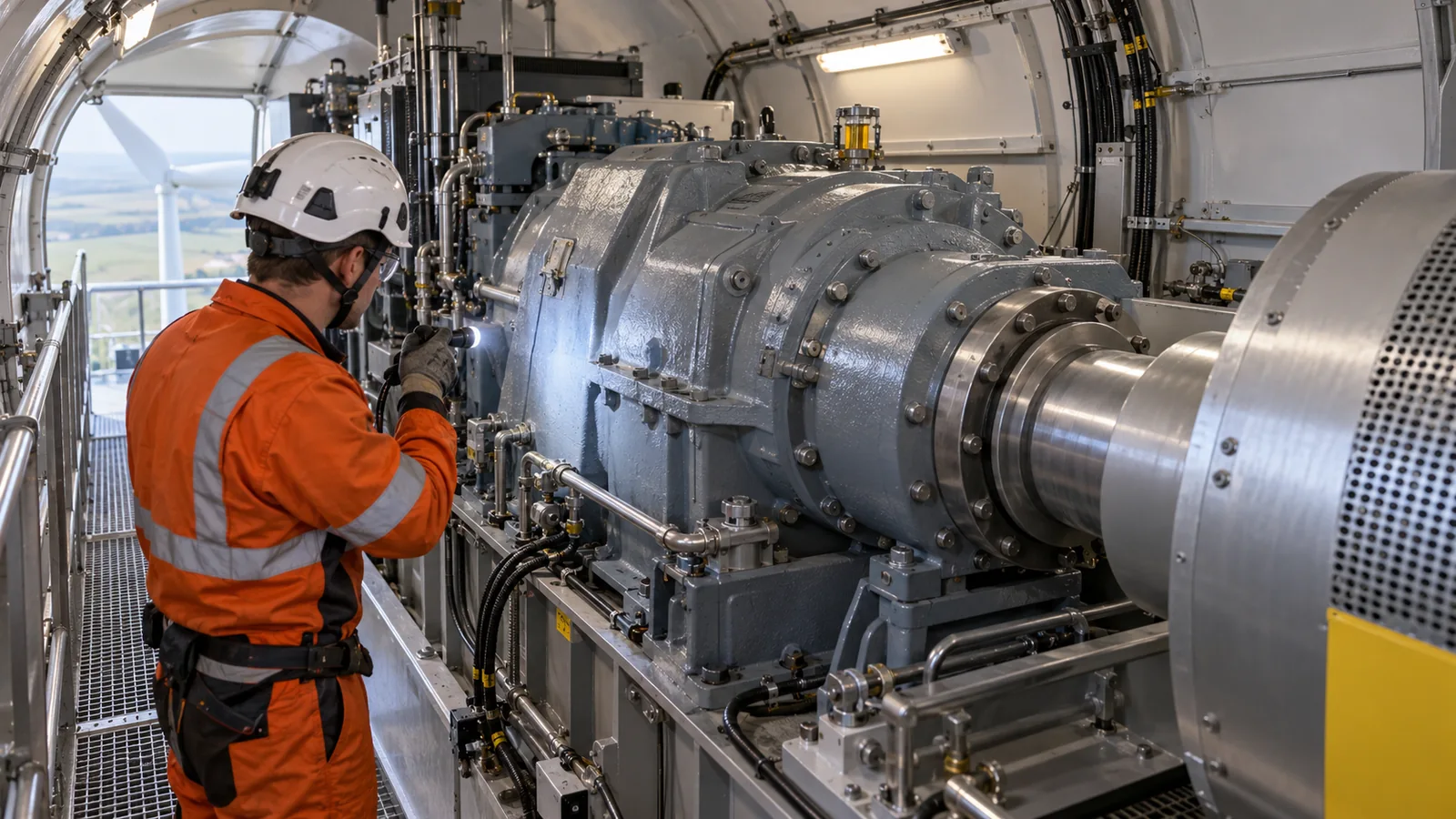
Gearbox, main bearing and generator exchanges are rare but large events, often needing a main crane. If your contract excludes major components, hold a reserve for them.
How the cost to maintain a wind turbine changes over its lifetime
The cost to maintain a wind turbine is not flat. Deutsche WindGuard's figures rise about 16% from the first to the second decade (49 to 57 €/kW, by our calculation), with maintenance and repair rising fastest.
- Warranty and initial service period. The manufacturer carries most defect risk. An end-of-warranty inspection is the last chance to have defects fixed at its expense.
- Post-warranty years. IRENA notes that renewal contracts for ageing fleets cost more, and many owners move from full-wrap to partial-wrap or independent service.
- Second decade. Deutsche WindGuard notes that major components may be excluded from contracts as turbines age.
- Life extension. Running past design life needs an assessment and often extra structural work. See our guide to life extension inspections.
This matters in Lithuania now. Litgrid reported 2.5 GW of installed wind capacity at the end of 2025, and Ignitis reported a record 759 MW of new onshore wind in 2025. Typical warranty periods are short compared with a 25-30 year life, so a large share of the Baltic fleet will need post-warranty contracts within a few years.
Access method as a cost lever
How technicians reach the work often decides the price of a repair more than the repair itself.
- Mobile crane. Needed for major component exchanges. Highest cost and most sensitive to wind, ground conditions and lead times.
- Blade or tower platform. Stable working position for longer blade repairs, but slower to rig and move.
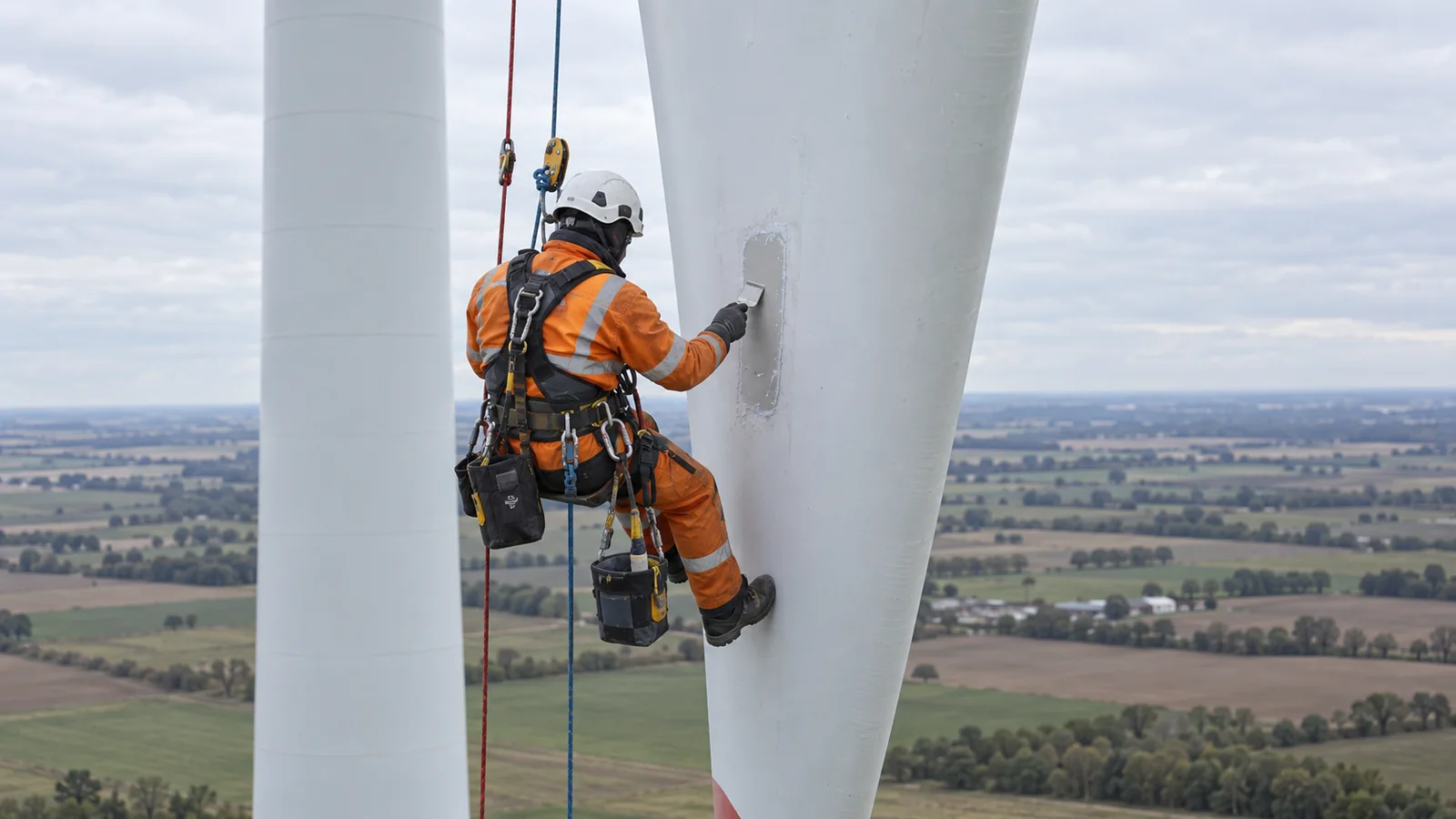
- Rope access. Fast to mobilise and move between turbines, suited to inspections and most blade and tower repairs. See our rope access services.
- Drones and robots. Good for inspection data and some cleaning or coating tasks; repairs usually still need people.
We have not found a neutral public benchmark that prices these methods per job, so ask suppliers to quote the same scope on each method.
Offshore wind turbine maintenance cost
Offshore is roughly twice as expensive per MW. IRENA reports a global weighted average fixed O&M cost of USD 102/kW per year for offshore wind in 2024, with a 5th to 95th percentile range of USD 76 to 121. The Danish Energy Agency's 2025 estimate for fixed-bottom offshore is €44,000 per MW per year in 2020 euros. Citing Wood Mackenzie, IRENA puts turbine maintenance at about 60% of offshore O&M, operational support at 19% and insurance at 11%. Vessels and weather windows explain the gap; see how offshore maintenance differs from onshore.
How to budget: a checklist for Baltic and Nordic owners
- Separate the service contract price from the full operating budget, and list what each excludes.
- Record the currency, price year and indexation clause for every quote.
- Check whether gearbox, main bearing, generator and blades are inside or outside the contract.
- Book an end-of-warranty inspection several months before expiry, leaving time to file claims.
- Hold a reserve for unplanned repairs and crane mobilisation.
- Budget for the second decade at a higher level than the first.
- Ask for blade and tower repair quotes by access method.
At Gridinta we price onshore wind turbine maintenance per scope, so we do not publish a standard price list. A wind turbine maintenance cost budget built on these steps is easier to defend to lenders and boards.