
How Much Does Wind Turbine Blade Repair Cost, and When Is Replacement Cheaper?
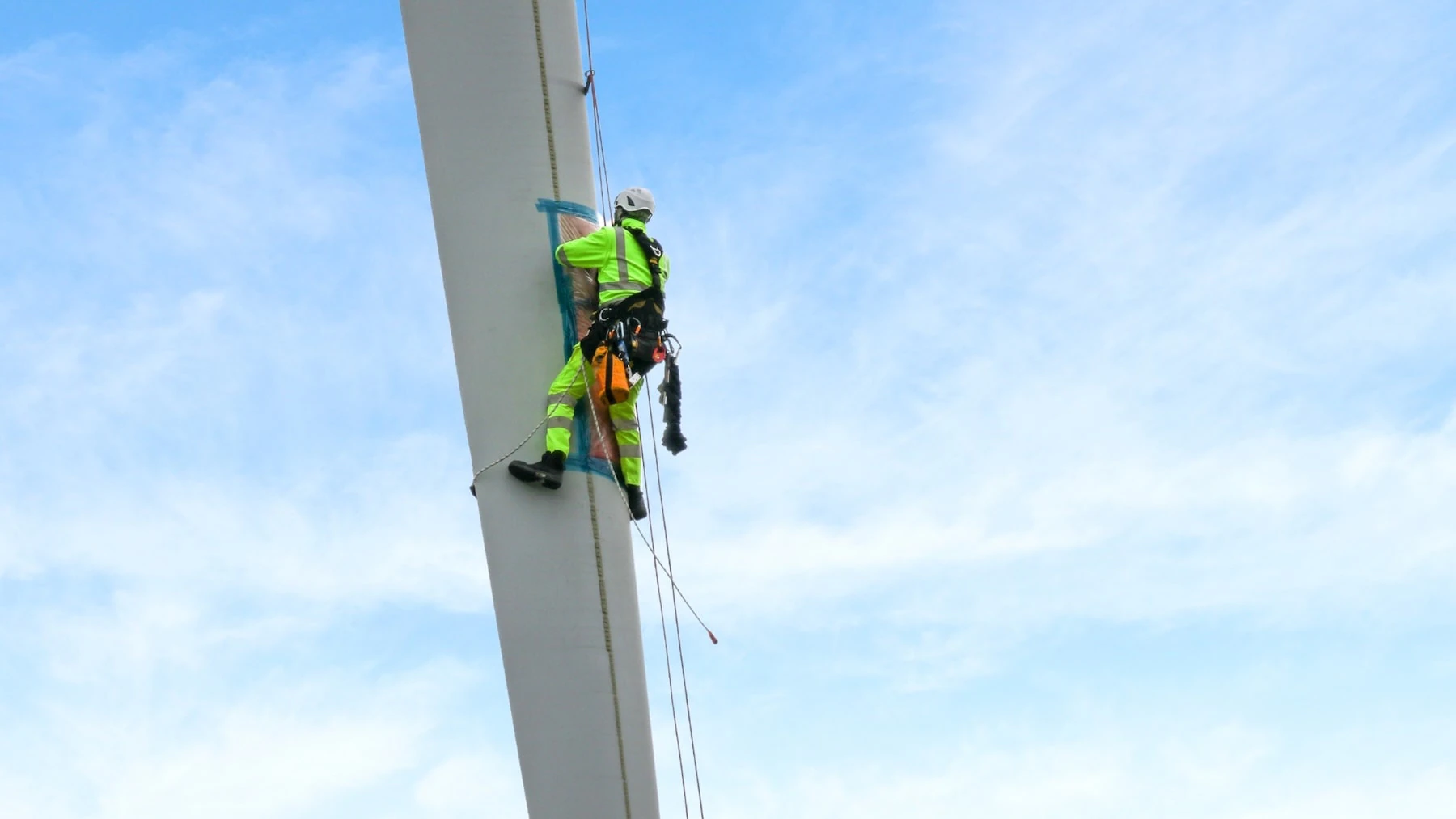
There is no public price list for wind turbine blade repair, and the best published figures are old. A US study for NREL put a non-structural blade repair at roughly USD 16,000 to 23,000 and a structural repair with a crane at USD 154,000 to 318,000, in 2010 dollars. A replacement blade costs around USD 80,000 to 300,000, before crane and downtime. What you actually pay depends on the damage category, the access method, the weather window and how long the turbine stands still.
As of October 2026. All figures carry their source year, currency and region. They are benchmarks for budgeting, not quotes, and none of them is a Gridinta price.
Published blade repair and replacement cost figures
Few owners or contractors publish what blade work costs. The table collects the figures we could trace to a source, oldest data first in each group. Treat the US numbers from 2010 and 2011 as historical baselines: turbines, blades and labour rates have all changed since.
| Item | Published figure | Year, currency, region | Source |
|---|---|---|---|
| Non-structural blade repair, 1.5 to 3 MW turbines | USD 16,000 to 23,000 per event (parts about USD 12,000 to 13,000, labour USD 4,000, no crane) | 2010 USD, US onshore | DNV for NREL, 2012 |
| Structural blade repair with crane, 1.5 to 2 MW | USD 154,000 per event (parts USD 88,000, labour USD 23,000, crane USD 44,000) | 2010 USD, US onshore | DNV for NREL, 2012 |
| Structural blade repair with crane, 2.1 to 3 MW | USD 318,000 per event (parts USD 223,000, crane USD 72,000) | 2010 USD, US onshore | DNV for NREL, 2012 |
| Average blade repair | Up to USD 30,000 | 2011, US trade estimate | CompositesWorld, 2011 |
| Leading-edge repair, per rotor | EUR 10,000 to 20,000 (study assumption) | 2018, Denmark, 850 kW turbine | Bech et al., Wind Energy Science, 2018 |
| Multi-day erosion repair campaign | About EUR 2,000 per day per turbine onshore; about EUR 20,000 offshore | 2023 to 2026 project, Germany | Fraunhofer IFAM, MARiLEP |
| Replacement blade | Around USD 80,000 to 300,000 per blade | 2023, industry estimate | ONYX Insight in Power Engineering, 2023 |
| Onshore crane rental | USD 10,000 to 50,000 per day; mobilisation can be almost half the crane cost for a single repair | 2023, US | Windpower Engineering, 2023 |
| Offshore jack-up vessel | GBP 116,250 (winter) to 172,500 (summer) per day, plus mobilisation (model inputs) | About 2014, UK | Dalgic et al., Ocean Engineering, 2015 |
| Average blade insurance claim | USD 240,000 including business interruption, before deductible | 2012 claims, US | GCube via Windpower Engineering, 2013 |
Public data is thin, and that is the honest headline. Current crane and jack-up rates are not published, and OEM blade prices are negotiated per contract. For a European onshore site in 2026, the most useful number is a quote built on your own inspection data.
Why blade repair costs range so widely
The same crack can cost a few thousand euros or a few hundred thousand, depending on where it is, how deep it goes and how you reach it. The drivers below explain most of the spread.
| Driver | Lower-cost case | Higher-cost case |
|---|---|---|
| Damage category | Category 1 to 2 surface or coating damage | Category 4 to 5 structural damage near the root or spar |
| Materials and LEP | Filler and coating touch-up, fast-curing systems | Laminate rebuild, shell or tape LEP across long spans |
| Access method | Rope access, one to two technicians | Main crane to lower the blade or rotor |
| Weather window | Dry, mild season with low wind | Cold or wet season, heating tents, standby days |
| Crew mobilisation | Several turbines repaired in one campaign | One urgent turbine, crew and equipment sent alone |
| Downtime | Repair while other turbines run; short stop | Turbine stopped for weeks waiting for parts or crane |
| Location | Onshore, good road access | Offshore, vessel and weather dependent |
Damage category sets the scope
Most inspection reports grade blade damage on a 1 to 5 scale. It is worth knowing that this scale is industry practice, not a standard. EPRI's 2020 white paper on blade damage categorisation states plainly that there is no standard system. In its survey of 112 respondents, most treated categories 1 and 2 as minor, 3 and 4 as moderate and 5 as major. Typical responses were to keep operating and re-inspect at category 1 to 3, and to repair within months at category 4. Category 5 means not safe to operate until repaired or replaced.
The blade standards IEC 61400-5 and DNV-ST-0376 cover blade design and manufacture but do not publish a repair price scale. That matters for quotes: ask each contractor which scale their inspection uses, so a category 3 means the same thing on every bid.
Small repairs add up. A 2020 DTU study by Mishnaevsky and Thomsen found that minor failures, mainly surface erosion, cost about 12 times more in total unplanned repairs than structural failures, simply because they are so frequent. Catching damage at category 2 rather than 4 is usually the single biggest saving. Our guide to preventing rotor blade damage covers the prevention side, and turbine inspection intervals covers how often blades are checked.
Materials, leading-edge protection and curing
Material cost is often a small share of an up-tower repair. Time is the expensive part, and much of that time is curing. Repair resins have a minimum working temperature. A 2023 Siemens Gamesa patent application notes that repair materials can usually be used down to 15 C but not below, and that work cannot go ahead outside the temperature and humidity window. Heating tents extend the season but add equipment and hours.
Faster curing cuts labour directly. A 2022 TORQUE conference paper by Mishnaevsky and co-authors estimated that moving from 4-hour heat curing to 20-minute UV curing could cut field labour cost by about 9 to 10 times for the steps involved.
Leading-edge protection (LEP) is the most common repair scope. The choice between filler and coating, tape or shells changes both cost and durability. The leading-edge erosion guide explains how to grade erosion before choosing a repair, and blade cleaning and coating covers surface protection.
Leaving erosion unrepaired has a production cost. Sandia's leading-edge erosion programme reports that a heavily eroded blade can reduce annual energy production (AEP) by up to 5% for a utility-scale turbine. The IEA Wind Task 46 AEP loss model (February 2025) gives smaller figures by erosion category:
| Erosion category | AEP loss at 4 m/s mean wind | AEP loss at 10 m/s mean wind |
|---|---|---|
| Category 2 | 1.0% | 0.4% |
| Category 3 | 1.9% | 0.8% |
| Category 4 | 3.0% | 1.6% |
In the field, ORE Catapult's BLEEP project found that repairing moderate erosion on one offshore turbine type gave a 1.5% to 2% AEP uplift, as reported in 2016. ORE Catapult noted that this was one turbine type, site and erosion level.
Access method: rope, platform or crane
How technicians reach the blade often decides the bill more than the repair itself.
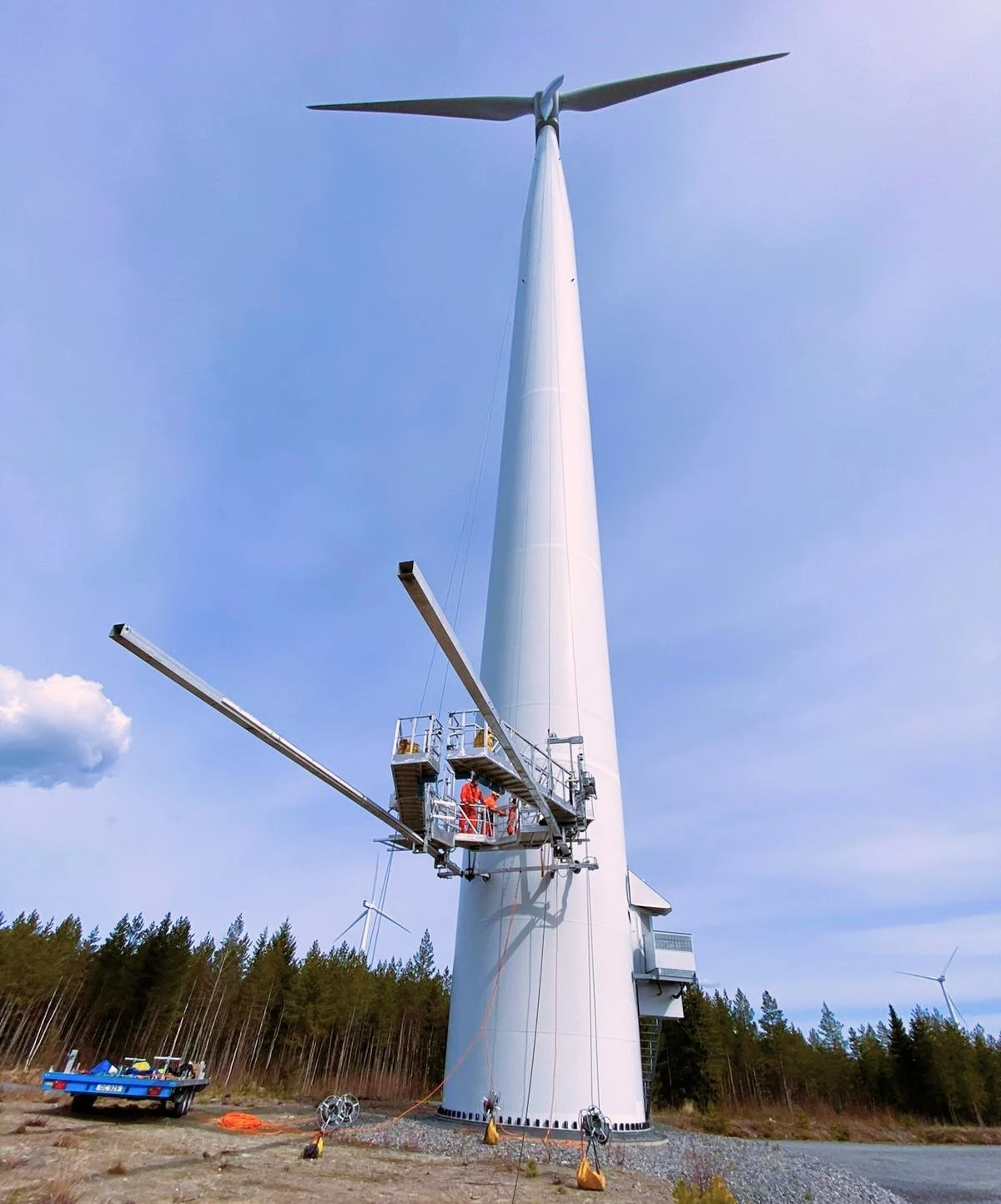
- Rope access is quick to rig and move between turbines. The Spanish Wind Energy Association's guide to rope work (2014) recommends ropes for blade inspection and for short or urgent repairs, up to about two weeks per turbine. It sets a general maximum wind speed of 12 m/s with the rotor locked and limits tools carried on the rope to 10 kg. See rope access techniques in wind.
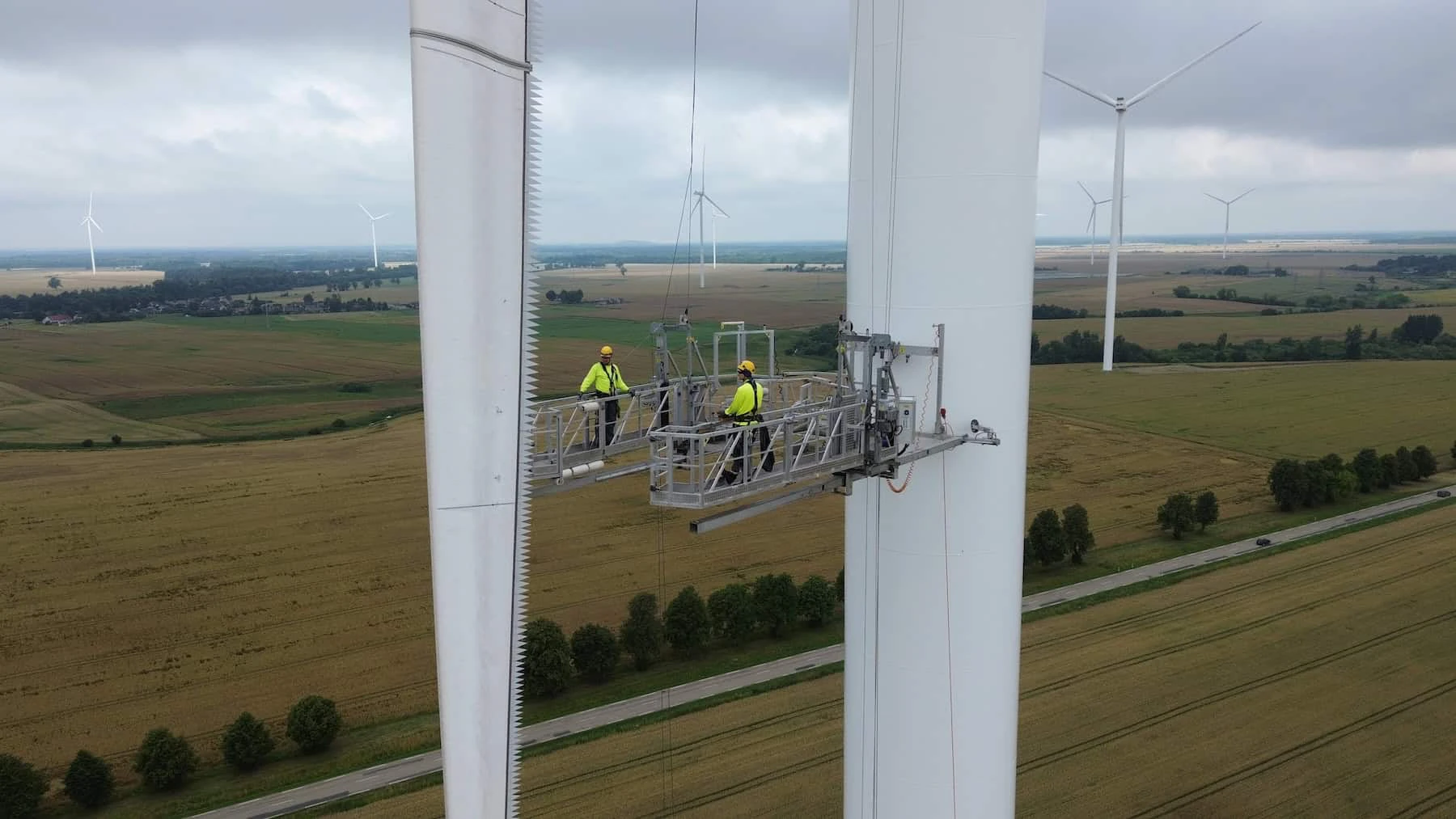
- Suspended platforms give a stable, enclosed workspace for longer laminate repairs and tight curing control. They take longer to rig and move, and they are bulkier to transport.
- Cranes are needed to lower a blade or rotor for major structural repair or replacement. The NREL study found an exchange takes about 3 to 5 days once the crane is on site, but crane and part lead times usually exceed the repair time. A crawler crane needs 10 to 20 truckloads to move.
A 2013 Wind Systems article described ropes and baskets as much less expensive than a large crane, and noted that cranes stop at lower wind speeds than ropes or platforms. We found no published, quantified cost comparison of the three methods. Ask for quotes by access method, as our maintenance cost guide recommends.
Weather windows and season
In the Baltic and Nordic markets, the practical repair season is short. Low temperatures stop resin work, wind above the contractor's limit stops rope work, and rain stops surface preparation. Every day a crew waits on site is paid standby. Plan category 2 and 3 repairs for the warm months, and keep urgent category 4 and 5 repairs on a separate, faster track. Our article on wind turbine icing problems covers winter constraints.
Crew mobilisation and campaign size
Travel, equipment transport and set-up are fixed costs per mobilisation. Spreading them over ten turbines rather than one changes the cost per repair sharply. The same logic applies to cranes: mobilisation can be almost half of the crane cost for a single turbine repair, according to Windpower Engineering (2023). A fleet-wide inspection first, then a planned repair campaign, is usually cheaper than reacting turbine by turbine.
Downtime and lost production
Lost production is often the largest cost of a blade problem. A simple way to size it, by our calculation: a 4 MW onshore turbine at a 30% capacity factor produces about 29 MWh a day. At an assumed EUR 60 per MWh, that is about EUR 1,700 of revenue per day of standstill. A week waiting for a crane costs about EUR 12,000 before any repair. Use your own capacity factor and price; in low-price hours, the loss is smaller.
Slow losses matter too. On the same turbine, a 1.6% AEP loss from category 4 erosion at a high-wind site is about 168 MWh a year, or roughly EUR 10,000 at that price. That sets a ceiling on what an early leading-edge repair needs to cost to pay back.
Onshore versus offshore blade repair costs
Offshore repairs cost more because of vessels, weather and longer transfers. The 2022 TORQUE paper estimated offshore maintenance at 2 to 3 times onshore, and Fraunhofer IFAM's figures are ten times higher per day offshore. A blade exchange offshore needs a jack-up vessel. Wood Mackenzie estimated in 2021 that Europe would spend EUR 3.9 billion on offshore major component replacements in the 2020s, EUR 1.6 billion of it on jack-ups. Offshore failure data is classed by material cost; the Carroll et al. (2016) study of about 350 offshore turbines splits repairs into minor (under EUR 1,000), major (EUR 1,000 to 10,000) and replacement (over EUR 10,000). See how offshore maintenance differs from onshore.
Wind turbine blade replacement cost and when replacement wins
Replacement is the right call when damage exceeds the OEM's repair limits, when the root or spar is compromised, or when repeated repairs no longer hold. The blade itself, at around USD 80,000 to 300,000 according to ONYX Insight (2023), is only part of the cost. Add the crane, transport, balancing of the rotor and the standstill. On older turbines, ONYX also noted that moulds for some blade models no longer exist, which can make replacement slow or force a whole rotor change.
Insurers see blades often. GCube reported blade damage as 41.4% of its 2012 US claims. Marsh's Nordic wind loss report 2026, covering about 2,500 onshore turbines in Sweden, Norway and Finland, found blades were the most-claimed component at 40% of claims. A 2014 GCube estimate put global blade failures at about 3,800 a year out of about 700,000 blades in service; treat that as a dated estimate, not a current rate. Replaced blades also need a disposal route; see what happens to decommissioned blades in Europe.
How to get blade repair quotes you can compare
- Start with a current inspection: photos, locations, dimensions and category for each finding, on a stated scale.
- Ask each contractor to price by finding and by access method, with mobilisation shown separately.
- Ask what the repair procedure is, which materials and LEP system, and the temperature and humidity limits.
- Ask how weather standby is charged and who carries the risk of lost days.
- Ask for the documentation you will receive: before and after photos, material batch records, cure records and sign-off.
- Compare total cost including your own lost production, not only the contractor's price.
Where Gridinta fits
Gridinta's blade repair services cover rotor blade inspection and repair with composite materials and vacuum curing, edge reworking and protective coatings, as part of our wider onshore wind services. Work is done on ropes or from suspended platforms, chosen per task and site. We are an IRATA member company (6036/O) and can plan multi-turbine campaigns to share mobilisation costs. Send us your inspection findings and we will price them line by line.