
What BOSIET Covers, How Long It Lasts and When Wind Technicians Need It
BOSIET (Basic Offshore Safety Induction and Emergency Training) is OPITO’s initial course for offshore oil and gas safety, helicopter emergencies, sea survival, first aid and firefighting. The usual classroom-and-practical format takes about three days, with FOET refresher training due within four years. Offshore wind employers commonly require GWO Sea Survival for vessel transfers. If the job includes helicopter travel, confirm the HUET or BOSIET product and breathing-system variant the operator accepts before booking.
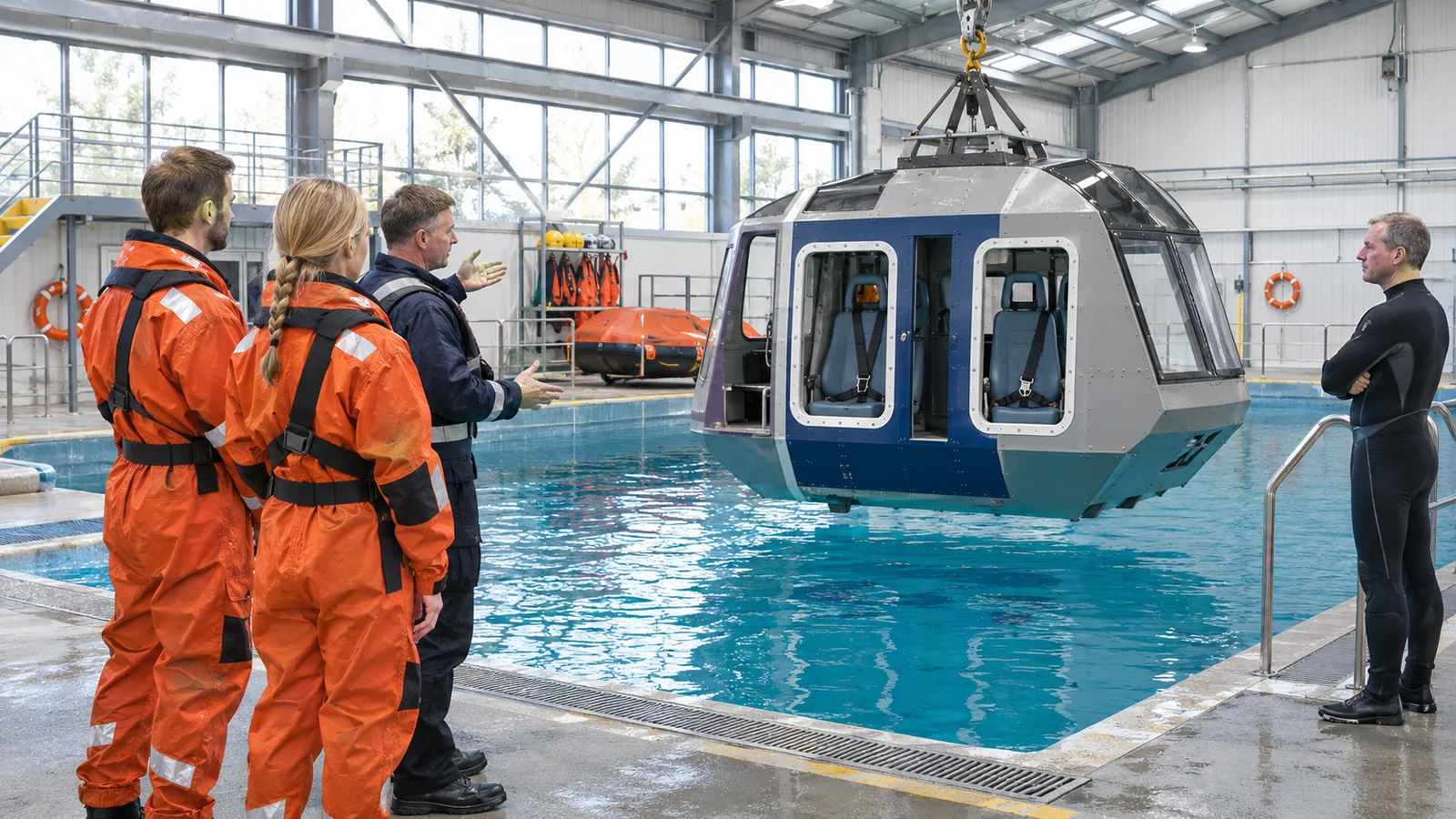
What the OPITO BOSIET standard covers
OPITO publishes BOSIET as a family of standards, and the version matters. BOSIET with CA-EBS (OPITO code 5750) is the one the UK and Danish sectors of the North Sea use. It is written for people new to, or returning to, offshore oil and gas who will be issued a compressed air emergency breathing system on their helicopter flights. The standard sets 20 hours 40 minutes of guided learning across four mandatory units. The safety induction is all theory; the other three units are roughly 40% theory and 60% practical.
- Safety Induction: offshore hazards, their risks and controls, the main offshore safety regulations and basic safety management.
- Helicopter Safety and Escape: helicopter travel and emergencies, using the CA-EBS, and escaping from a ditched helicopter in a simulator. This is the HUET element.
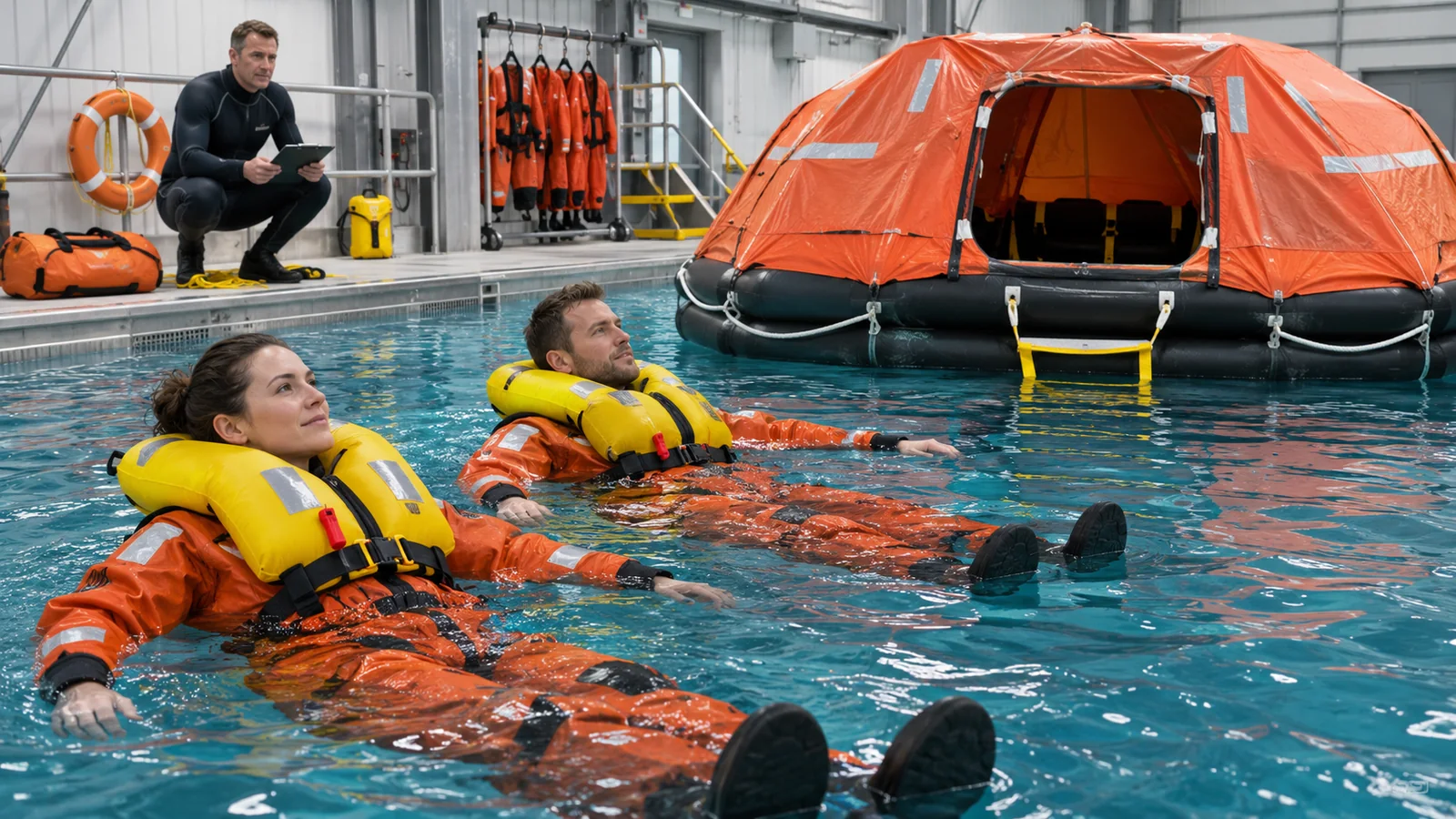
- Sea Survival and First Aid: evacuation, survival techniques in the water and emergency first aid.
- Firefighting and Self-Rescue: basic firefighting equipment and self-rescue in low visibility, including smoke-filled areas.
The practical list shows what the three days involve. At Novikontas in Riga, the BOSIET with CA-EBS programme includes escaping through an underwater exit from a partially submerged helicopter simulator and from a capsized one, putting on and using the CA-EBS, winching to a simulated rescue aircraft, boarding a marine life raft from the water, mustering and strapping in as a TEMPSC passenger, tackling Class A and contained Class B fires with portable extinguishers, and wearing a smoke hood in a smoke-logged area.
Other versions change the breathing system or the delivery. BOSIET with EBS (5700) trains with a rebreather and sets 21 guided hours. The digital-delivery versions (5752 with CA-EBS, 5703 with EBS) move the theory online before a practical assessment at an approved centre. Tropical BOSIET (T-BOSIET, 5501) is written for offshore work in a tropical environment and sets 19 guided hours.
What CA-EBS means, and when the course needs it
CA-EBS stands for compressed air emergency breathing system: a small air supply worn on offshore helicopter flights so that a passenger can breathe underwater while escaping a ditched or capsized cabin. For UK offshore helicopter operations, the Civil Aviation Authority’s guidance on rule SPA.HOFO.165(c) says the breathing system should meet Category A of the CAA specification CAP 1034, prEN/EN 4856 or an equivalent specification.
The North Sea recognition scheme labels OPITO training with CA-EBS as Category A and rebreather-based training as Category B. The two are different products with different codes, so book the variant the operator names and check that the code on your joining instructions matches it before you travel.
Helicopter travel in some regions, including the UK, also needs a valid shoulder breadth measurement. OPITO offers it as a separate product (code 9365) at approved centres, so ask whether your centre can take the measurement while you are there for BOSIET.
Who asks for BOSIET, country by country
BOSIET is an oil and gas industry requirement, and the installation operator or duty holder decides which product it accepts. For platform work such as offshore oil and gas maintenance by rope access, its training matrix names the product, the breathing-system variant and the medical. OPITO reported more than 240 approved training centres worldwide in December 2024.
Around the North Sea, the UK, Norway, Denmark and the Netherlands each use their own basic safety standard, and the industry bodies publish a shared recognition matrix. The version valid from 4 March 2026 reads as follows.
Scroll horizontally to see all table columns.
| Working in | Local standard | Holder of UK OPITO BOSIET/FOET with CA-EBS | Holder of Norwegian Guideline 002 training |
|---|---|---|---|
| United Kingdom | OPITO BOSIET/FOET with Category A EBS | Home standard | Accepted with additional Category A EBS training |
| Denmark | OPITO BOSIET/FOET with Category A EBS | Accepted | Accepted with additional Category A EBS training |
| Netherlands | NOGEPA Standard 001, training course 0.5 | Accepted | Accepted with additional Category A EBS training |
| Norway | Offshore Norge Guideline 002 | Accepted with additional escape chute and Category B rebreather training | Home standard |
For Norway, the rebreather addition can be met with the OPITO rebreather codes the matrix lists (5095, 5700, 5701, 5703, 5858 and 5859), alongside escape chute training. The scheme covers OPITO BOSIET and FOET with CA-EBS only, so tropical BOSIET and FOET certificates fall outside it. For work in any other region, including the US Gulf of Mexico, ask the hiring company which product it names before you pay for one.
BOSIET and MIST in the UK sector
In the UK sector, BOSIET can sit alongside MIST, OPITO’s Minimum Industry Safety Training (code 5301). MIST has five units: major accident hazards, workplace hazards and personal safety, risk management, control of work, and helicopter safety. It runs over about two days (13.5 hours of contact time), lasts four years and is renewed with MIST Further (5311). OPITO expects offshore workers to take it after BOSIET, and the North Sea matrix lists MIST as the extra a Danish BOSIET holder needs before working in the UK.
How long BOSIET lasts and when to book FOET
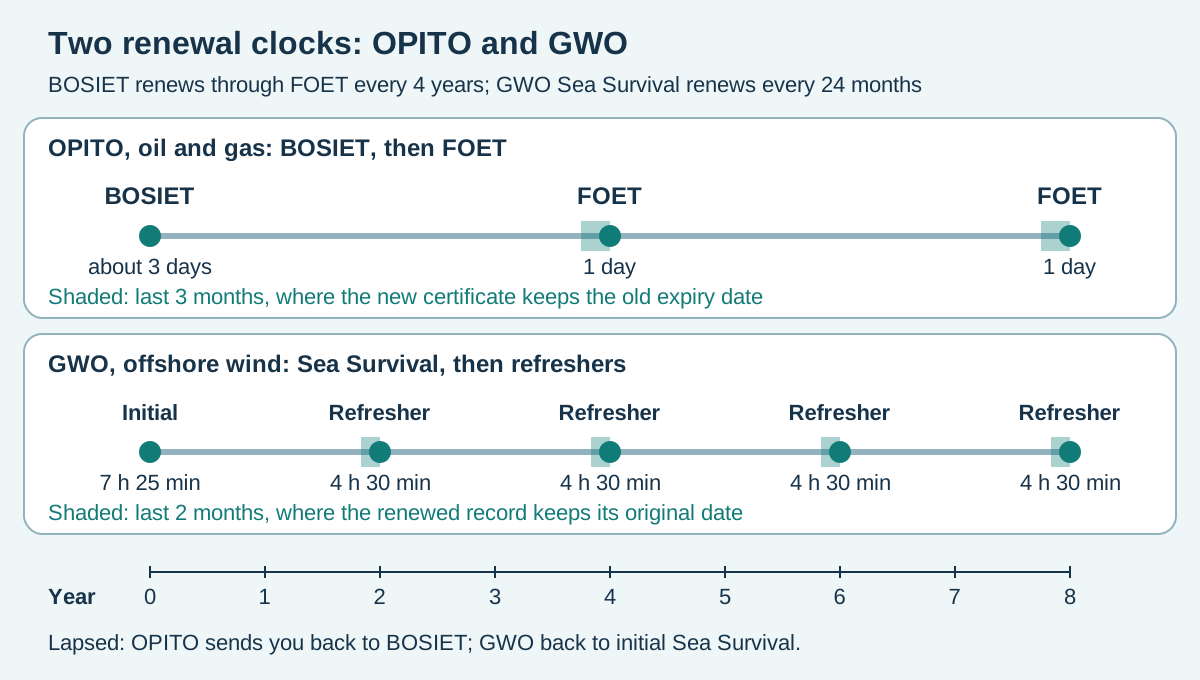
A BOSIET certificate lasts four years. OPITO sets four years as the maximum interval between completing BOSIET and completing FOET (Further Offshore Emergency Training), and each FOET restarts the four-year clock. FOET with CA-EBS (code 5850) sets 8 hours of guided learning including the introduction, usually one day, across three mandatory units built around helicopter emergencies and escape, firefighting and self-rescue, and basic first aid.
Two OPITO rules decide when to book it:
- FOET needs an in-date certificate. Entry is open to holders of a valid OPITO BOSIET (with CA-EBS or EBS), T-BOSIET, FOET or T-FOET. Once yours lapses, FOET is closed to you and the route back is the full BOSIET, which OPITO writes for people new to, or returning to, offshore work.
- Renewal within the final three months can preserve the anniversary. If your existing certificate expires within three months of the FOET enrolment date, the new certificate takes the old expiry date, unless the duty holder or operator says otherwise.
A worked example: if the expiry printed on your BOSIET certificate is 12 March 2030, a FOET course in January or February falls inside the three-month forward-dating window. Ask the centre to use that existing expiry as the dating reference and check the replacement certificate when issued. Complete the refresher before the printed expiry; waiting until April leaves an expired BOSIET outside the normal FOET entry requirements.
Is the BOSIET course hard to pass?
BOSIET is written for newcomers, so it assumes no offshore experience. What it demands is practical: about 60% of the time in the three units after the induction is hands-on, and OPITO’s standards are outcome-based. The digital version, for example, requires every learner to be formally assessed against all outcomes at an approved centre, and those outcomes include escaping from a helicopter after a ditching in a simulated environment. OPITO also states that learners must be able to take part safely in physically demanding and potentially stressful activities.
The underwater work is concentrated in the helicopter unit: escaping through windows from a partially submerged and a capsized simulator, and breathing from the CA-EBS in the pool. Novikontas states a ratio of four learners per instructor for practical sessions and sixteen per instructor for theory.
Before you start, the centre checks medical fitness. The OPITO standard accepts one of the following:
- a valid, current offshore medical certificate, such as the OEUK medical;
- an employer-approved medical certificate equivalent to an offshore medical;
- a valid, current certificate of medical fitness to work at sea;
- a valid, current certificate of medical fitness for diving at work;
- the approved centre’s own medical screening form.
If your certificate carries a restriction, bring evidence from a registered medical practitioner that it does not relate to respiratory or ear, nose and throat conditions. For the shallow-water CA-EBS exercises you also make a declaration on the day, before entering the water. Tell the centre about any restriction when you book, and ask what happens if you cannot complete an exercise on the day.
Where GWO Sea Survival fits for offshore wind
Wind turbine work runs on a different scheme. The Global Wind Organisation’s Basic Safety Training standard, version 20 of 10 March 2026, has five modules: First Aid, Manual Handling, Fire Awareness, Working at Height and Sea Survival. Sea Survival is the offshore module, with 7 hours 25 minutes of contact time for initial training and 4 hours 30 minutes for the refresher. Its timetable covers:
- cold water immersion: exposure, cold shock, hypothermia, drowning, seasickness and contaminated water;
- life-saving appliances and PPE, search and rescue, GMDSS and transponders, and actions that make you easier to find;
- a 160-minute practical session: entering the water from a transition piece ladder, individual and group swimming techniques, using a life raft and emergency descent by constant rate descender;
- safe travel and transfer between vessels, from dock to vessel and from vessel to installation, plus awareness of motion-compensated walk-to-work gangways;
- a 135-minute transfer practical between a crew transfer vessel and a turbine transition piece.
The module is built around vessel access. Its timetable contains no helicopter escape exercise, so a wind technician who is flown offshore needs separate helicopter training.
A GWO Sea Survival record is valid for 24 months. Under section 5.5 of the standard, renewing up to two months before expiry keeps the original certification date, renewing earlier gives a new date, and an expired record means taking the initial module again. Records sit in WINDA, GWO’s training database, so you need a WINDA ID before the course. The guide to GWO certification and WINDA records covers the other modules.
CTV, SOV or helicopter: the transfer decides the training
GWO Sea Survival trains the vessel transfers used to reach turbines: from a crew transfer vessel to the transition piece, and across gangways from a service operation vessel. The comparison of CTV, SOV and walk-to-work turbine access explains where each is used and what limits it.
Helicopters change the requirement. In April 2026 OPITO noted that distant, deep-water and floating wind sites, projects more than 50 km from shore and urgent maintenance where a vessel transfer is unsafe can rely on helicopters. Its position is that HUET applies to anyone who travels offshore by helicopter, whatever the sector. Ask the wind farm operator which helicopter escape product it accepts, and with which breathing system.
When a technician needs both certificates
- You work across both sectors. A rope access technician who moves between oil and gas platforms and offshore wind farm maintenance faces two checks: BOSIET or its local North Sea equivalent for the platform, and a GWO Sea Survival record in WINDA for the wind farm.
- You are moving from oil and gas into wind. A BOSIET does not appear in WINDA, so a wind employer that lists GWO Sea Survival expects the GWO module. The guide to proving oil and gas skills for wind turbine work covers the rest of the switch.
- A wind project flies you offshore or hoists you from a helicopter. Keep GWO Sea Survival for the vessel side and add the helicopter training the operator names. HUET with CA-EBS (code 5295) covers the helicopter unit on its own: 7 hours 10 minutes of guided learning, valid for four years.
Holding both means running two renewal clocks, one of four years and one of 24 months.
BOSIET, FOET, HUET and GWO Sea Survival side by side
Scroll horizontally to see all table columns.
| Course | Built for | Training time | Validity and renewal |
|---|---|---|---|
| BOSIET with CA-EBS (OPITO 5750) | People new to, or returning to, offshore oil and gas who fly with a CA-EBS | 20 h 40 min guided learning; usually 3 days | 4 years to complete FOET; if it lapses, BOSIET again |
| FOET with CA-EBS (OPITO 5850) | Holders of an in-date BOSIET, T-BOSIET, FOET or T-FOET | 8 h including introduction; usually 1 day | 4 years; renew with another FOET |
| HUET with CA-EBS (OPITO 5295) | Helicopter emergencies and escape only, in one unit | 7 h 10 min guided learning; 1 day | 4 years |
| GWO BST Sea Survival (V20) | Offshore wind work reached by crew transfer vessel or walk-to-work gangway | 7 h 25 min initial; 4 h 30 min refresher | 24 months; refresher before expiry, initial module again if it lapses |
Medical, weight and shoulder-breadth checks for offshore travel
Training entry and offshore mobilisation involve separate medical checks. A centre’s medical screening form may satisfy course entry without being the offshore medical accepted by your employer. Confirm the operator’s requirements; the guide to the OEUK offshore medical explains the examination. For flights to UK installations covered by OEUK’s safe-weight policy, check the 124 kg offshore travel limit and any required shoulder breadth measurement before mobilisation.
Booking BOSIET or GWO Sea Survival from the Baltics
Gridinta’s training partner Novikontas delivers both schemes. On 11 November 2026 its OPITO course list included BOSIET with CA-EBS (5750) and with EBS (5700), digital-delivery versions of each (5752 and 5703), FOET (5850 and 5858), HUET (5295 and 5095) and an offshore escape chute course (5770). The BOSIET, FOET and HUET course pages we checked name Riga. GWO Sea Survival including boat transfer runs in Riga and Klaipėda, either as one day at the centre or as e-learning followed by practice there.
The digital BOSIET with CA-EBS puts the four theory units online; you then attend one practical day in Riga, which Novikontas says must happen within 90 days of finishing the online part.
Before you book:
- Get the requirement in writing from the employer: scheme, product name, code and breathing system (for example, BOSIET with CA-EBS, 5750), plus any MIST, escape chute or shoulder breadth addition.
- Check that your medical certificate is valid on the course dates. For GWO courses, create your WINDA ID.
- Choose a date on the Novikontas course calendar and confirm the city, language and practical day.
- Check the current fee for that exact code on its course listing, such as BOSIET with CA-EBS in Riga or FOET with CA-EBS in Riga, and confirm what it includes before paying.
- For wind modules beyond Sea Survival, see the GWO courses Novikontas runs in Klaipėda and Riga.
To see where BOSIET sits among the IRATA, GWO and medical requirements for rope access roles, use the offshore rope access course checklist.
BOSIET questions to settle before you book
How many years is a BOSIET certificate valid?
Can I take FOET if my BOSIET has already expired?
Can BOSIET be done online?
How much does a BOSIET course cost?
Will a wind farm accept BOSIET instead of GWO Sea Survival?
What is the difference between BOSIET and HUET?
Is MIST the same as BOSIET?
Is a UK BOSIET accepted in Norway and the Netherlands?
Sources
Sources checked on 11 November 2026:
- OPITO standards library: BOSIET with CA-EBS (5750), BOSIET with EBS (5700), BOSIET with CA-EBS digital delivery (5752) and Tropical BOSIET (5501).
- OPITO refresher and related standards: FOET with CA-EBS (5850), FOET with EBS (5858), HUET with CA-EBS (5295), MIST (5301) and MIST Further (5311).
- OPITO news: how OPITO HUET supports Europe’s wind workforce (14 April 2026) and essential offshore safety training, BOSIET and HUET (12 December 2024).
- Offshore Norge: mutual recognition scheme for basic safety training on the North Sea, valid from 4 March 2026.
- UK Civil Aviation Authority: guidance material for compliance with SPA.HOFO.165(c), version 01, 2 August 2018.
- Global Wind Organisation: Basic Safety Training Standard V20 (10 March 2026), including module durations, section 5.4, validity rules, section 5.5 and the Sea Survival timetable, section 15.6.
- Novikontas course pages: OPITO course list, BOSIET with CA-EBS, BOSIET with CA-EBS digital delivery, FOET with CA-EBS, HUET with CA-EBS and GWO Sea Survival.