
7 Wind Turbine Icing Problems Nordic and Baltic Operators Should Plan For

Wind turbine icing causes seven recurring problems in Nordic and Baltic winters: lost output, ice throw, misleading sensors, rotor imbalance, costly stop-and-restart decisions, harder technician access, and very short weather windows for blade repairs. Each one can be planned for. The owners who suffer least decide their ice detection, stop rules, exclusion zones and repair timing before the first icing event, not during it.
How much does wind turbine icing cost in the Nordics?
Wind turbine icing happens when supercooled cloud droplets or freezing rain hit a cold surface and freeze. On a turbine the worst place for it is the blade, because the outer third of the blade produces most of the power and moves fastest.
Wind turbine icing losses are measurable. In its study of more than 30 operational Nordic wind farms and 90 met masts, DNV reports icing losses above 50% in some winter months and more than 10% of annual production at some sites. DNV also found a strong link between hub-height altitude and icing loss at many Swedish sites, and noted that the icing climate appears to become more severe further east, towards Finland.
For owners in Sweden, Finland, Norway and the Baltic states, that means cold climate wind is a planning topic for operations, safety and maintenance, not only for the energy yield report.
Problems that affect output and public safety
1. Lost output when ice changes the blade's aerodynamics
Even a thin layer of rime or glaze ice on turbine blades roughens the leading edge and changes the airfoil shape. Lift drops, drag rises and the turbine produces less power at the same wind speed. Heavy accretion can stop the turbine entirely.
The power curve is the best early signal. If measured output falls well below the expected curve while temperature is near or below 0 °C and humidity is high, ice is the likely cause. Leading edges that are already eroded can collect ice and lose performance faster, which is one reason to deal with leading edge erosion on onshore blades before winter.
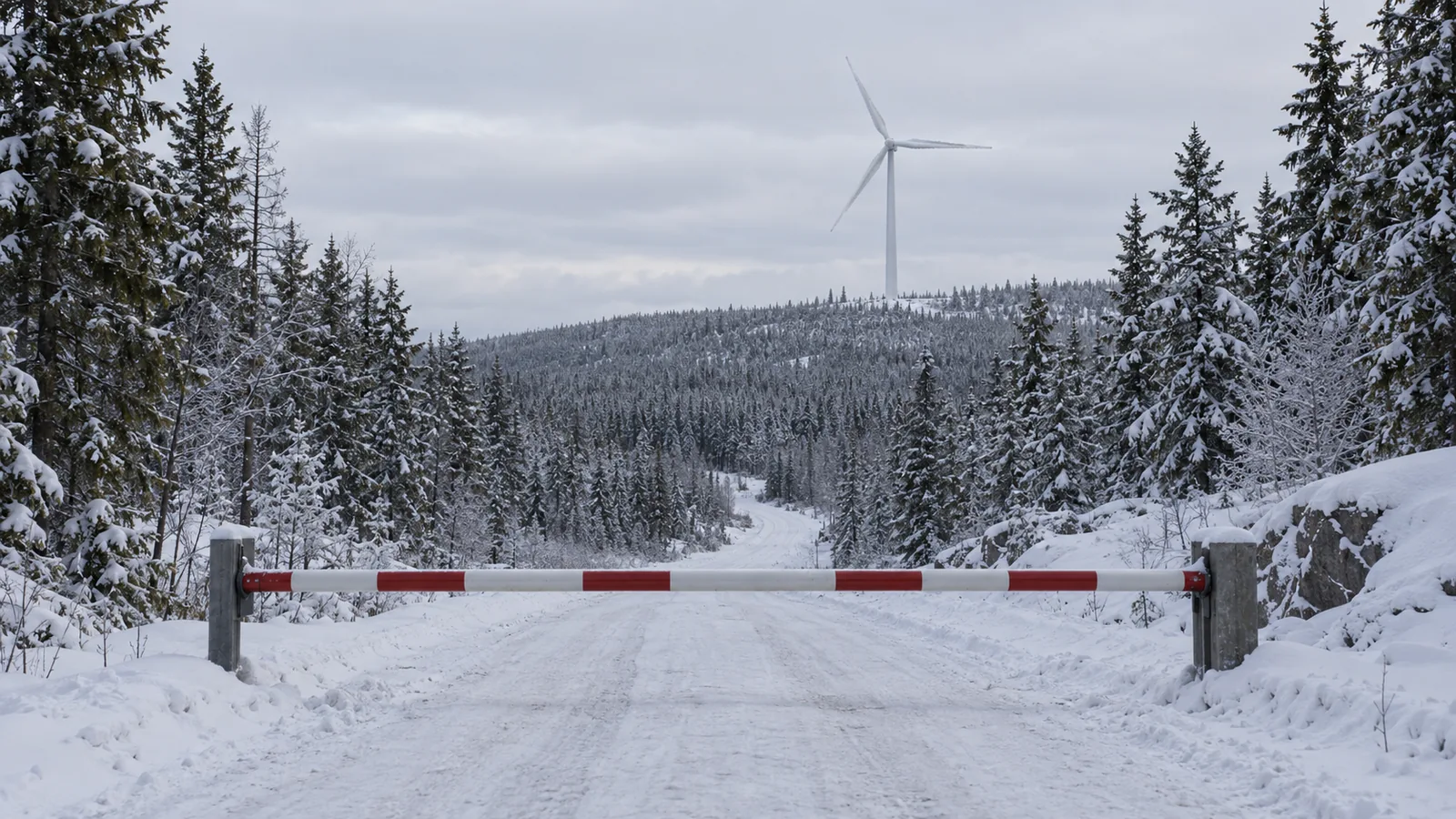
2. Ice throw and ice fall near roads, paths and work areas
Ice that breaks off a rotating blade can be thrown well beyond the tower. Ice from a stopped turbine falls closer, but wind still carries it. Both are a risk to people on access roads, hiking or ski trails, hunting areas and, above all, to service crews.
A widely used screening rule, the Seifert formula, puts the ice throw distance at d = 1.5 × (hub height + rotor diameter). By our calculation, a turbine with a 120 m hub and 160 m rotor gives about 420 m. A 2025 UiT The Arctic University of Norway master's thesis concludes that this rule is probably conservative, with field data and models suggesting it overestimates real throw distances.
Treat the formula as a first screen, not a guaranteed safe distance. The IEA Wind TCP Task 19 international recommendations for ice fall and ice throw risk assessments, second edition published in 2022, describe how to assess risk site by site. They also stress that national law and local permits still apply.
Problems inside the turbine and its control system
3. Iced sensors that mislead the controller
During wind turbine icing, cup anemometers and wind vanes on the nacelle ice up just like blades. An iced anemometer under-reads wind speed, and a frozen vane can give a wrong wind direction, so the yaw system points the rotor badly. The controller may then curtail, misjudge the power curve, or fail to recognise that the rotor is iced.
Heated sensors, ultrasonic anemometers and a second independent measurement help. Check sensor heating in the autumn service, because a failed heater often goes unnoticed until the first icing event.
4. Mass and aerodynamic imbalance, vibration and extra loads
Ice rarely builds or sheds evenly. One blade can carry more ice than the others, which creates mass imbalance, and the changed airfoil shapes create aerodynamic imbalance. The result is extra vibration and fatigue loading on the blades, main bearing, drivetrain and tower.
Most turbines detect high vibration and stop. Repeated imbalance events are worth reviewing after winter, together with condition monitoring data, so they do not hide early bearing or blade damage.
5. Stops and restarts decided by ice detection
Ice detection is the core decision tool for managing wind turbine icing. A review of icing and icing mitigation by Sundén and Wu groups the methods into direct sensing of ice and indirect methods. In practice, operators use three main approaches:
- Nacelle-mounted ice sensors that detect icing conditions or ice on the sensor itself.
- Power-curve deviation, where the controller compares actual and expected output.
- Blade-mounted sensors, often vibration or frequency based, that detect added mass on the blades.
Getting it wrong costs money either way. A turbine kept stopped too long loses production after the ice has gone. A turbine restarted too early can throw ice or run unbalanced. Clear written rules for restart, including who may restart remotely and when a site visual check is needed, reduce both risks.
| Option | What it does | Main limit |
|---|---|---|
| Ice detection | Triggers stop or heating | Only as good as sensor and settings |
| Anti-icing heating | Keeps blade above freezing | Uses energy while running |
| De-icing heating | Removes ice, often when stopped | Production lost during cycle |
| Ice-phobic coatings | Lower ice adhesion | Durability on eroding edges |
| Operational stop | Avoids throw and loads | Lost production |
Blade heating systems are usually fitted at the factory or as a retrofit by the turbine maker. Research reviews generally find that passive coatings alone do not keep blades ice-free at harsh sites, so they work best alongside heating and detection. Coating condition also matters, as covered in our article on rotor blade cleaning and coating.
Problems for the people doing winter work
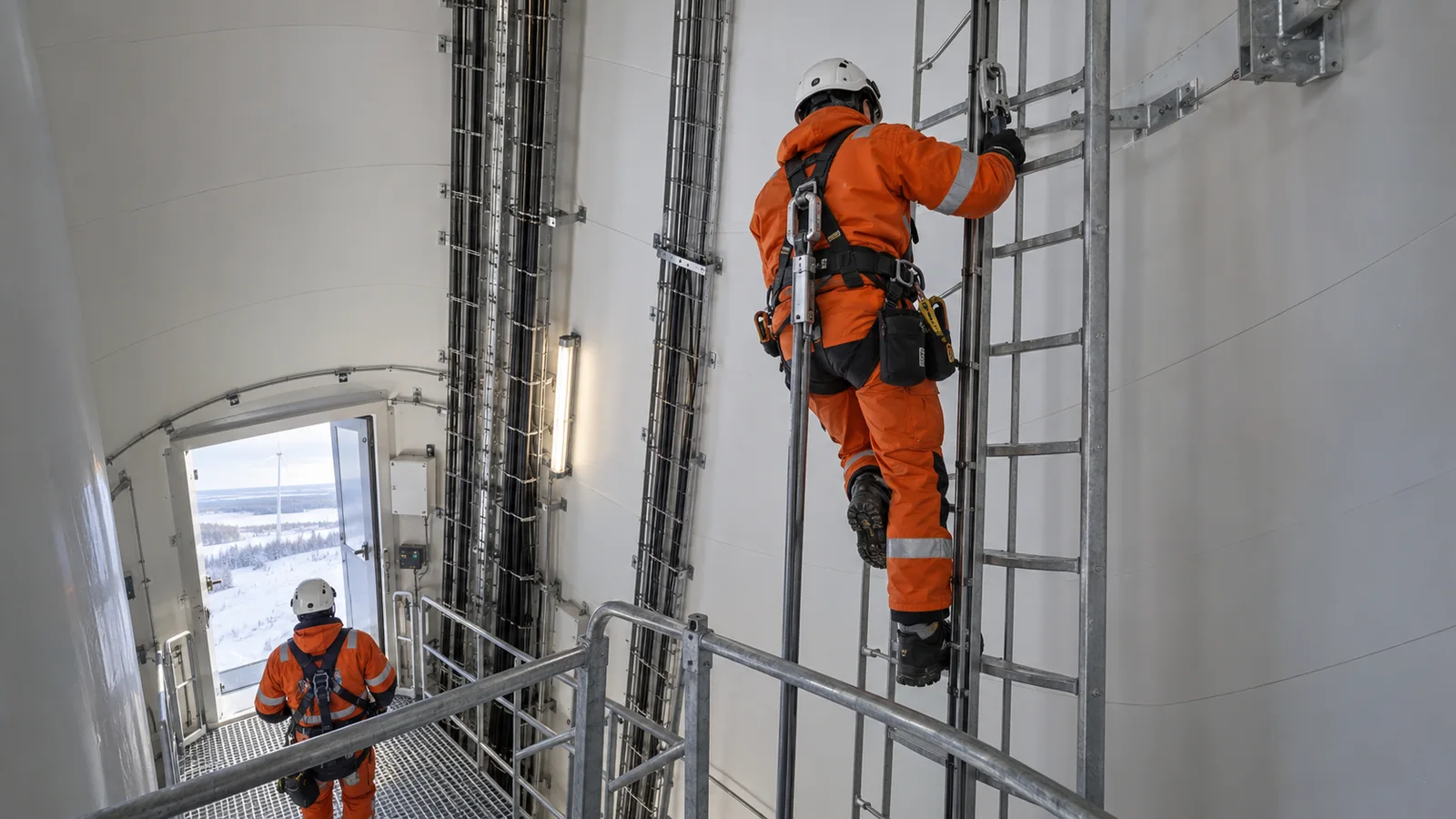
6. Safe access, climbing and rescue for technicians in the cold
Winter access is harder at every stage. Roads need ploughing, ice may fall from the rotor and nacelle, and towers are slow to climb in heavy cold-weather clothing. Rope access adds its own points to plan:
- Ropes and textiles can stiffen or ice, which affects handling and descender performance.
- Battery tools, powered ascenders and radios lose capacity in the cold.
- Daylight in northern Finland and Sweden is only a few hours in December, so work windows shrink.
- Cold stress reduces dexterity and concentration, so shorter rotations and warm-up breaks matter.
- Rescue plans must work with frozen equipment and longer response times.
IRATA's analysis of 2023 member incident data, summarised in its five key lessons from WASA 2024, lists the working environment among recurring hazards, alongside dropped objects and rope damage. At Gridinta we plan winter rope access services around these constraints, including a rescue plan that is ready before anyone leaves the ground.
7. Short temperature and humidity windows for blade repairs and coatings
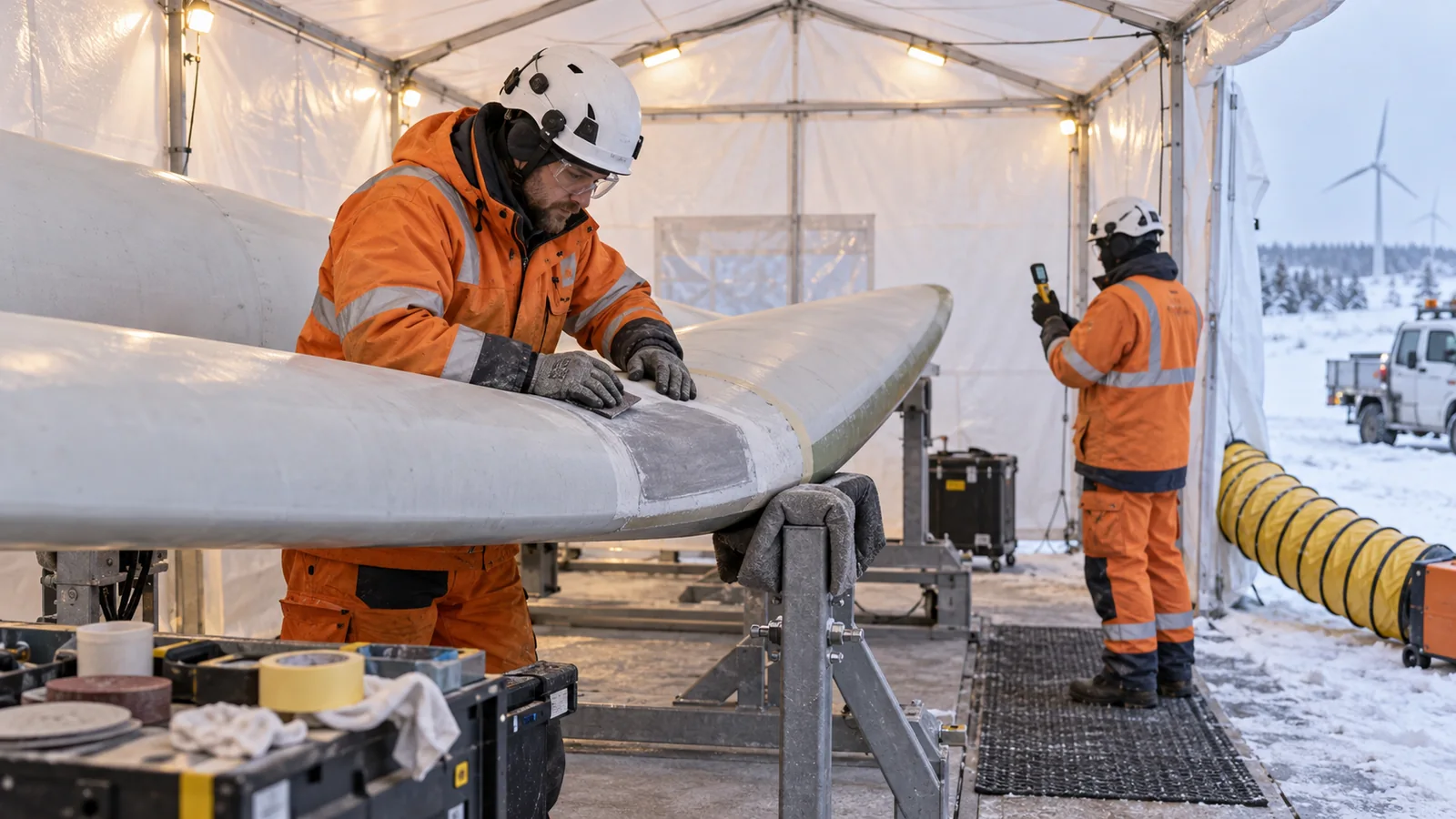
Most blade repair resins, fillers and leading edge protection coatings have minimum temperature and maximum humidity limits set in the manufacturer's technical data sheet. Below those limits, resins cure slowly or incompletely and coatings may not bond. Common coating practice also keeps the surface at least 3 °C above the dew point, an approach described in ISO 8502-4, to avoid condensation under the coating.
In a Nordic winter with frequent wind turbine icing, those conditions are rare on an exposed blade. Heated enclosures or habitats can create a workable local climate, but they add equipment, power and set-up time. Often the better plan is to make temporary safe repairs in winter and schedule structural repairs and coatings for late spring to early autumn. Our article on how long it takes to service a wind turbine explains how weather affects task duration.
Winter-readiness checklist for owners
Use this checklist alongside your regular onshore wind turbine inspection and maintenance checklist.
Before the icing season:
- Repair leading edge erosion and open blade damage while temperatures still allow it.
- Test sensor heating, ice detectors and blade heating systems.
- Review wind turbine icing detection settings and written stop and restart rules.
- Update ice throw risk assessments, signage and exclusion zones.
- Plan winter access, snow clearance, rescue and crew rotations.
During the season:
- Log every icing stop, restart and heating cycle.
- Keep crews out of exclusion zones while ice is present.
- Limit winter blade work to inspections and temporary safe repairs.
After the season:
- Compare actual icing losses with the yield forecast.
- Inspect blades for ice-related damage and coating wear.
- Review vibration alarms and plan summer repairs early.
If you want support with blade, tower or service-lift work around the icing season, see our onshore wind turbine maintenance services.