
What Happens When Lightning Strikes a Wind Turbine and How Owners Should Respond
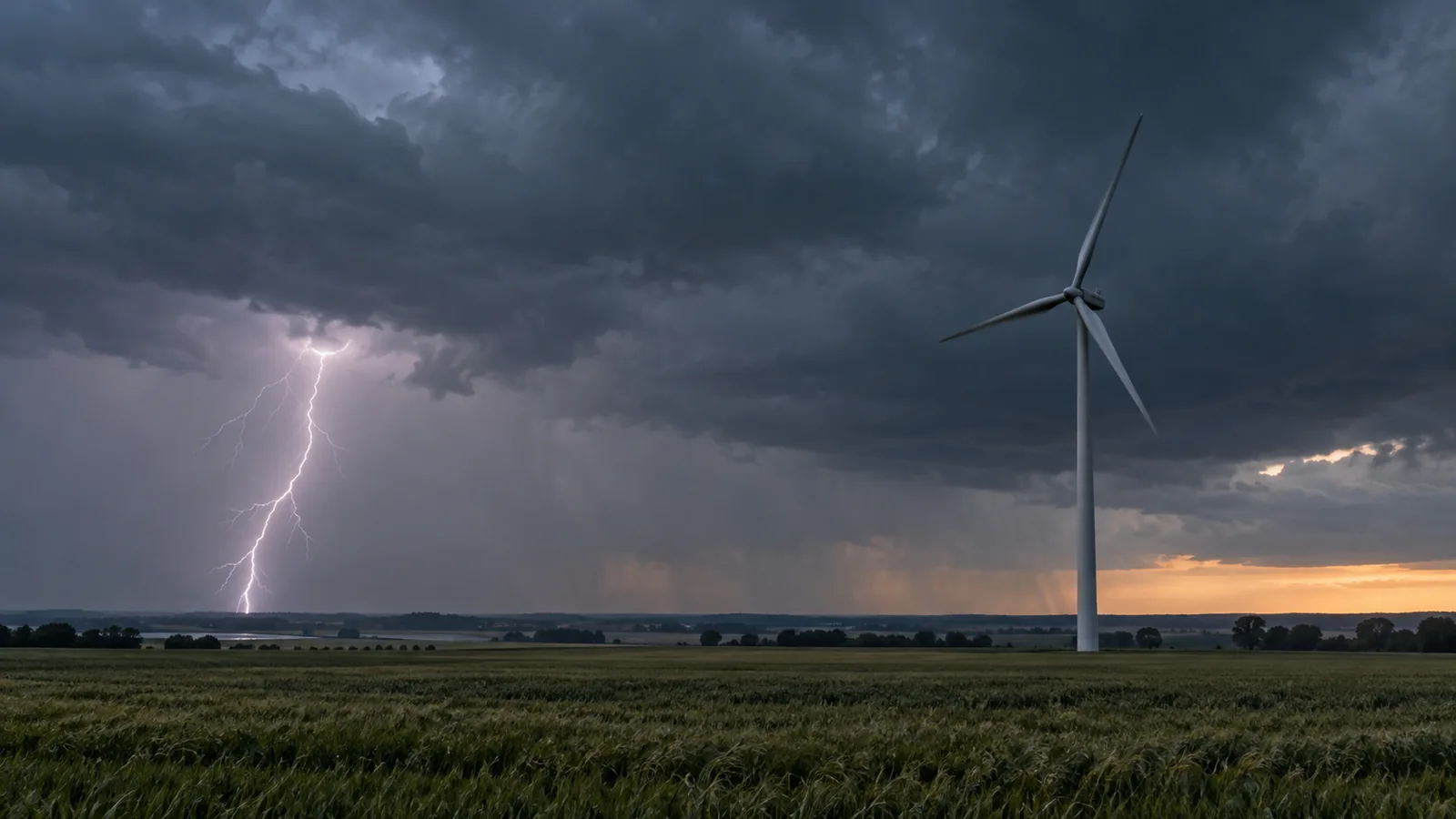
When lightning strikes a wind turbine, the current usually attaches to a metal receptor near the blade tip, runs down a conductor inside the blade, crosses the hub and nacelle through brushes or spark gaps, and flows down the tower into the earthing system. If that path works, the turbine often keeps running with little more than a scorched receptor. If any link in the path is broken or overloaded, the energy finds its own route, and the result can be split laminate, a burnt-out tip, damaged bearings or tripped electronics.
How often are wind turbines struck by lightning?
More often than most people expect. Xweather's analysis of more than 70,000 operational turbines in the United States, published in June 2026, found that 31.4% were struck at least once in 2025. The number of turbines hit four or more times rose 32.1% compared with 2024.
Strike rates vary a lot by site. In an Xweather interview with Matt Stead, blade monitoring by eologix-ping averaged about 4.4 cloud-to-ground strikes per tower per year. That sample is biased towards sites that already had lightning problems, so it shows a bad-case picture rather than a typical one.
Why taller turbines and some regions see more strikes
Height is the main driver. Taller towers and longer blades collect more downward strikes and can also start upward lightning, where a leader grows from the blade tip towards the cloud. The Xweather 2025 turbine analysis links tip heights above 115 metres with more repeated strikes.
Climate matters too. A PNNL study published in June 2025 found that US East Coast offshore wind areas received about 14 times the lightning strokes of operating North Sea wind farms between 2020 and 2022. European and Baltic exposure is therefore generally lower than in the US, but it is not zero. Winter lightning along northern coasts is a known risk for tall structures, and one damaged blade can take a turbine offline for weeks.
What gets damaged when lightning strikes a wind turbine
Most strikes cause no harm that needs repair. The ones that do usually fall into a few patterns.
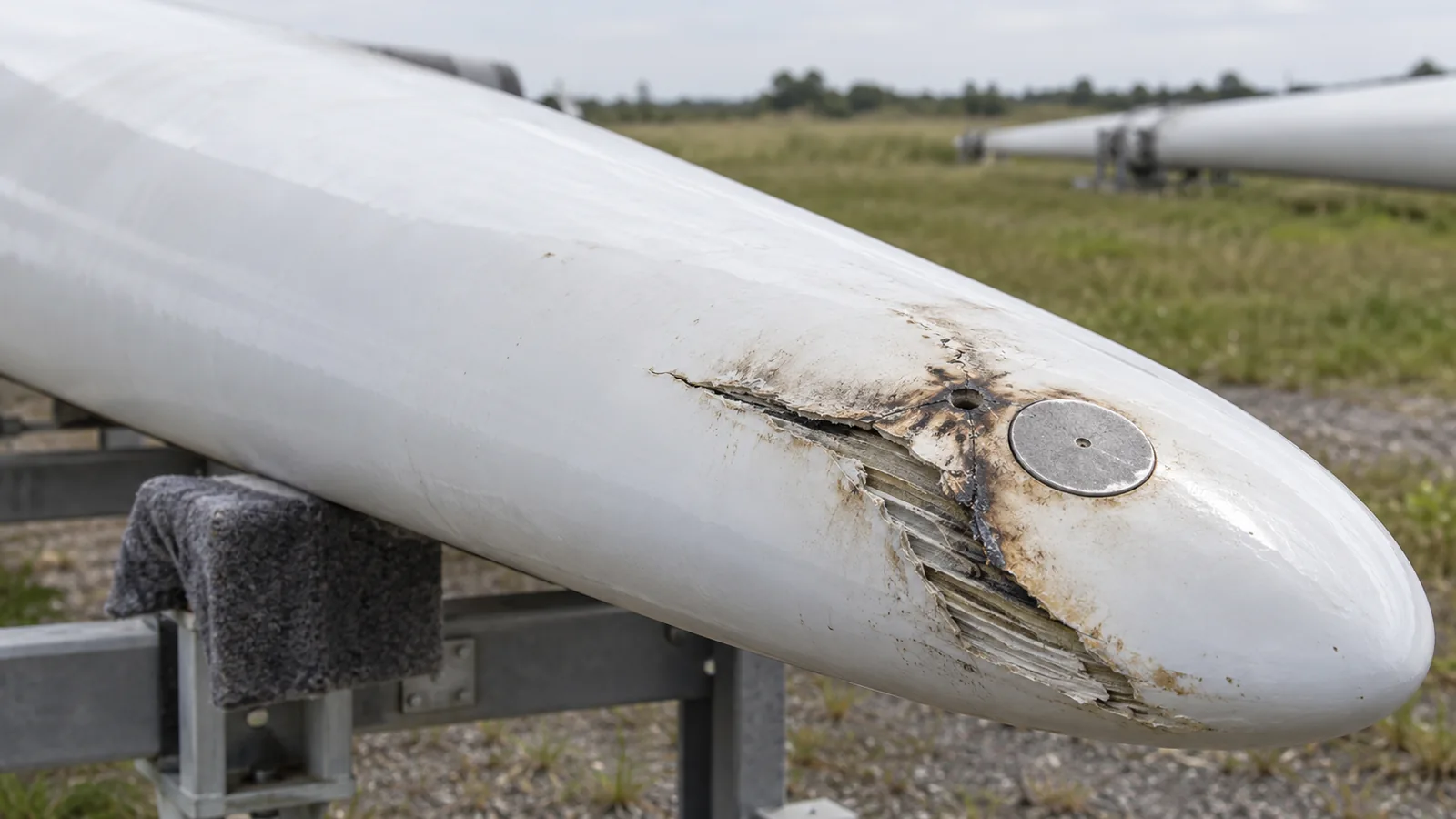
- Blade tip and receptor damage. The receptor melts or erodes at the attachment point. Minor pitting is normal; wear below the blade surface means replacement.
- Delamination and split laminate. If current arcs inside the blade, the shock wave and hot gas can separate laminate layers, open the bond lines or blow out the tip.
- Burnt laminate and punctures. Small holes or scorch marks appear where the arc passed through the shell rather than into a receptor.
- Down-conductor damage. Cables can separate from the receptor block or root terminal, often after repeated strikes or fatigue.
- Bearing pitting. Current that passes through pitch, main shaft or generator bearings instead of the designed bypass can leave small melt craters on raceways.
- Control electronics. Induced surges can destroy sensors, converter boards and communication links, even when the blade looks fine.
Wind Power LAB, citing an insurance loss database of more than 3,500 renewable claims, reports that lightning accounts for about 60% of operational blade losses. For context on other failure modes, see our guide to the most common failures in wind turbines.
How a wind turbine lightning protection system is built
Turbine lightning protection is covered by IEC 61400-24, Wind energy generation systems Part 24: Lightning protection. The current text, as of October 2026, is the consolidated IEC 61400-24:2019+AMD1:2024 published in November 2024. It defines the lightning environment, a risk assessment method, protection requirements for blades, structure and electrical systems, and test methods.
A typical wind turbine lightning protection system has these parts:
- Lightning receptors. Replaceable metal discs or tip caps on the blade surface that give the strike a preferred attachment point.
- Receptor blocks. Metal blocks cast into the blade that join each receptor to the down conductor.
- Down conductors. Cable, mesh or plates running inside the blade to the root terminal.
- Transfer systems. Brushes, sliding contacts or spark gaps that carry current across the pitch bearing, main shaft and yaw bearing so it does not pass through rolling elements.
- Bonding and earthing. Bonding of nacelle, tower sections and cabinets, connected to an earth electrode system at the foundation.
- Surge protective devices (SPDs). Wind turbine surge protection at the converter, transformer, control cabinets and signal lines to limit induced overvoltages.
According to Wind Power LAB's LPS explainer, many blade systems are designed and tested for peak currents in the range of 100 to 200 kA. Strikes above the design level, or a missing connection anywhere in the chain, are the two common reasons a protected blade still fails.
What to inspect after a lightning strike
Each time lightning strikes a wind turbine, an alert from a lightning location service, a SCADA trip or a blade monitoring sensor should start a defined check. The table below links each damage type to what should be checked.
| Damage type | Typical sign | What to check |
|---|---|---|
| Receptor burn or wear | Melted or missing receptor | Visual check, receptor replacement, resistance test |
| Tip damage or delamination | Open tip, cracks, bulging shell | Close visual and tap test on ropes or platform |
| Puncture or scorching | Small holes, black marks | Map position, check for internal arcing |
| Down-conductor break | Usually invisible outside | LPS continuity and resistance measurement |
| Transfer system wear | Brush wear, scorching at root | Brush contact, spark gap distance |
| Bearing current damage | Noise, vibration trend | Condition monitoring, oil analysis, endoscopy |
| Electronics and SPDs | Faults, tripped SPDs | SPD status indicators, fault logs, replacement |
What evidence insurers usually ask for
Lightning claims often turn on whether the strike exceeded the design level or the LPS was defective. Matt Stead notes in the Xweather interview that disputes between operators, manufacturers and insurers can keep turbines idle for long periods. Owners usually strengthen a claim by keeping:
- lightning location data showing time, position and estimated peak current;
- SCADA alarms and the exact stop time;
- dated photos of the damage before any repair;
- recent LPS inspection and continuity test records;
- the repair report with materials and method.
The exact list depends on the policy, so check its wording before a storm season.
How LPS continuity testing is done with rope access
Visual inspection finds burnt receptors, but it cannot show a broken connection inside the blade. That needs an electrical measurement. In a typical method, the rotor is locked and the blade is set vertically with the tip down. A rope access technician descends to each receptor, cleans the contact point and connects a low-resistance ohmmeter between the receptor and a reference point at the blade root or hub. The reading is recorded per receptor, together with photos.
The OEM procedure defines the test instrument, the method and the acceptance values. We do not apply generic limits, because they differ between blade designs.
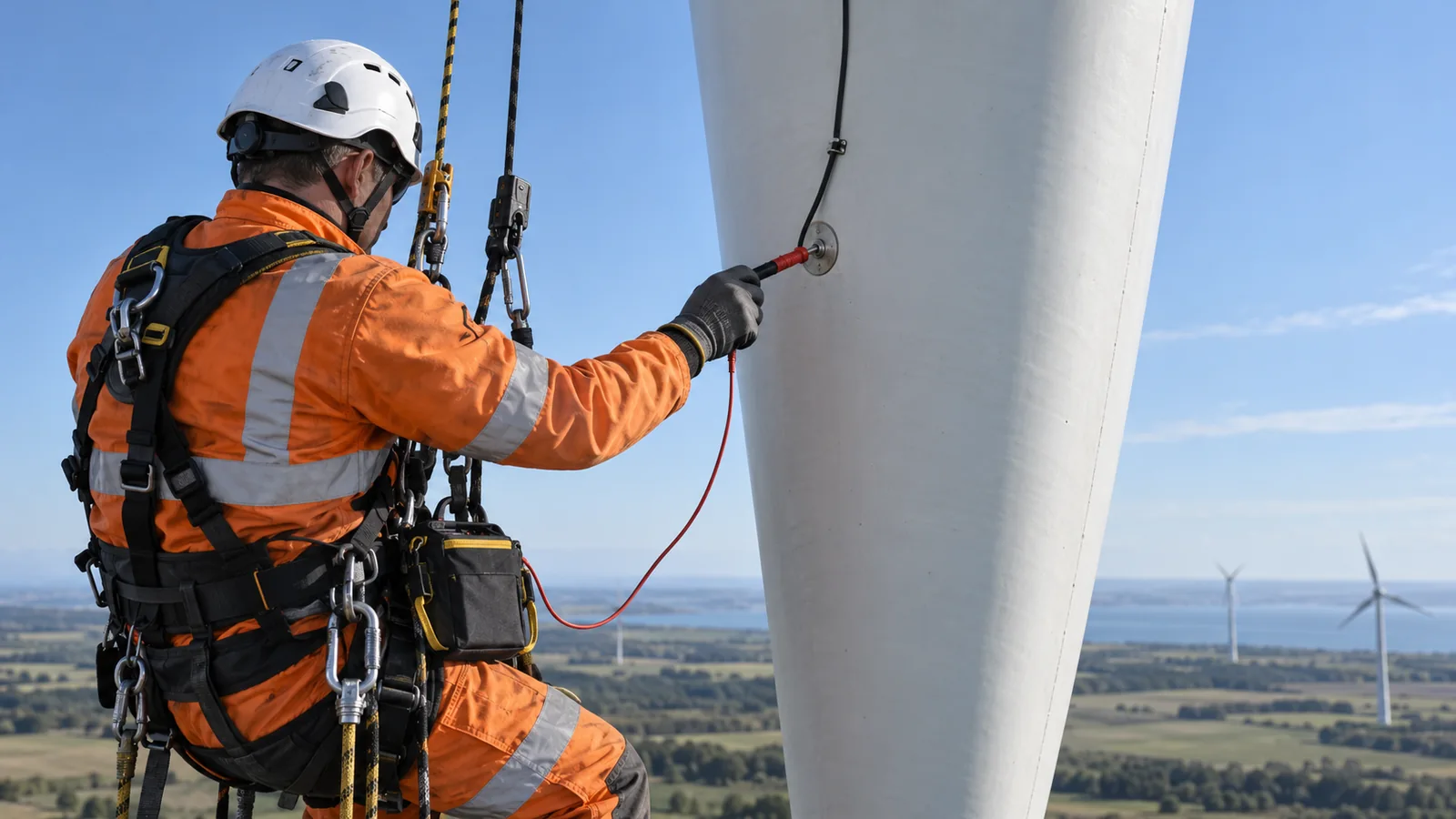
At Gridinta our IRATA rope access teams carry out blade inspection, repair and electrical work at height. This lets one mobilisation cover the visual inspection, the continuity test, receptor replacement and composite repair. It fits well into routine onshore wind turbine maintenance, and the reasons for regular checks are set out in why rotor blade inspections are essential.
Post-strike checklist for wind farm owners
When lightning strikes a wind turbine on your site, a short routine saves time later:
- Confirm the strike with lightning location data and match it to SCADA events.
- Keep the turbine stopped if a blade alarm, imbalance or abnormal noise appeared.
- Inspect the blades from the ground or by drone for obvious tip or shell damage.
- Check SPD indicators, fault logs and earthing connections in the nacelle and tower base.
- Schedule a close blade inspection and LPS continuity test following the OEM procedure.
- Review bearing and generator condition monitoring data for new trends.
- Photograph and document everything before repair, then notify the insurer.
Our onshore inspection and maintenance checklist shows where these checks fit in the annual plan.