
IRATA Wind Speed Limits and Other Weather Rules for Rope Access on Wind Turbines
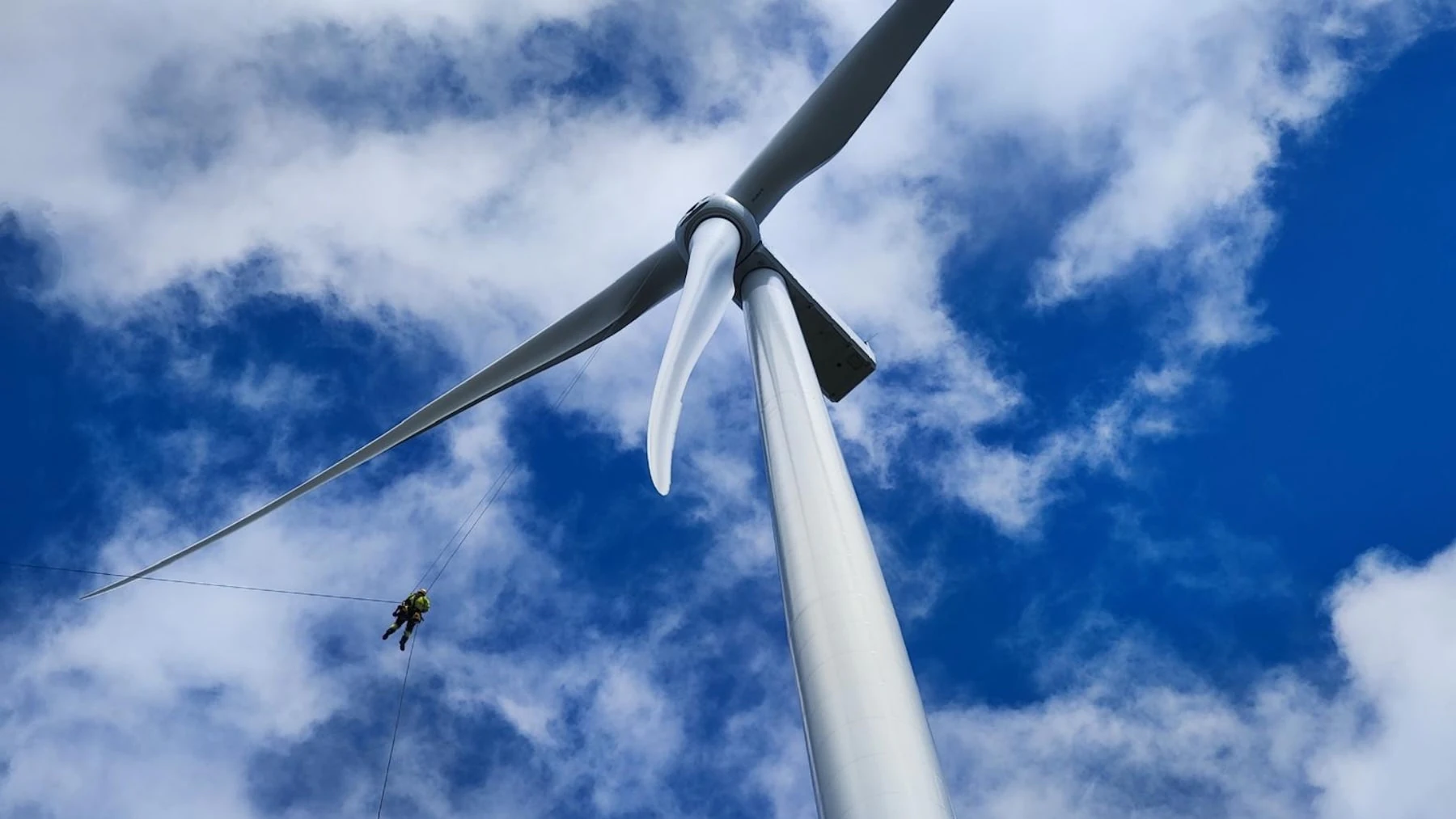
IRATA does not set one maximum wind speed for rope access. Its code of practice says there is no definitive limit, because the right one depends on the place of work, company policy and the task. It does suggest that a limit for direct exposure in the range of Beaufort force 4 to 5, or 8.0 to 10.8 m/s, could be appropriate. The working limit for a given job is then set in the risk assessment and method statement, checked against the turbine manufacturer's and the site's own limits, and enforced by the Level 3 supervisor. This guide explains each of those layers. It reflects the documents available as of October 2026.
What the IRATA code of practice says about wind
The guidance sits in Annex O of the IRATA International Code of Practice (ICOP), an informative annex on protecting rope access technicians against environmental conditions. IRATA describes Annex O as covering windy, wet and cold, and hot conditions and ultraviolet radiation. The version we reviewed is dated 1 August 2017. Its main points on wind are:
- No fixed number (O.2.2.2): there is no definitive maximum wind speed at which rope access work should be stopped, as it depends on many factors.
- A suggested range (O.2.2.3): for direct exposure to wind of benign temperature, a limit of Beaufort force 4 to 5 (8.0 to 10.8 m/s; 28.7 to 38.9 km/h) could be appropriate, with more frequent breaks and better clothing at the upper end.
- Balance (O.2.1.2): winds above about 10.3 m/s (37 km/h) are likely to affect a person's balance and increase the risk of a fall.
- Risk assessment (O.1.2): adverse weather must be part of the risk assessment, which should be ongoing as well as initial.
- Who decides (O.1.5): the rope access safety supervisor determines whether conditions are compromising safety and can stop the work. Any technician should be allowed to stop if they consider conditions unsafe.
Annex O also compares other trades. It notes that falsework guidance allows work up to Beaufort force 6, and that roofing guidance stops the handling of profiled sheets at a mean of about 10.3 m/s gusting to 35 mph, and of lightweight boards at about 7.6 m/s. A suspended rope access technician is more exposed than either, which is why the suggested range sits lower.
| Beaufort force | Mean wind speed | How Annex O uses it |
|---|---|---|
| 4 | 5.5–8 m/s | Lower end of the range suggested for direct exposure; lightweight roofing materials stop at about 7.6 m/s |
| 5 | 8–10.8 m/s | Upper end of the suggested range; balance affected above about 10.3 m/s |
| 6 | 10.8–13.9 m/s | Falsework example limit; above the suggested rope access range |
| 7 and above | 13.9 m/s and over | Well above any rope access figure discussed in the annex |
So the lead is correct, with a nuance. IRATA leaves the limit to the risk assessment, but it gives a starting range that many method statements use.
What SPRAT says about wind speed
The US-based Society of Professional Rope Access Technicians takes the same position. In a December 2020 FAQ, its Safe Practices Committee answers the question of whether SPRAT provides a maximum wind speed with a plain no. Instead, section 9.9.5.2 of its Safe Practices for Rope Access Work requires a review of the work environment before work, including the effects of wind on rope systems, positioning and the work environment.
SPRAT lists the factors to weigh: wind direction, speed and gustiness, the tools and equipment in use, the length of the rope system, and whether technicians can safely access, position at and leave the work. Section 5.3.5 gives every technician authority to stop work immediately if it is unsafe. For how the two schemes differ more widely, see IRATA vs SPRAT.
OEM, industry and site limits for blade and nacelle work
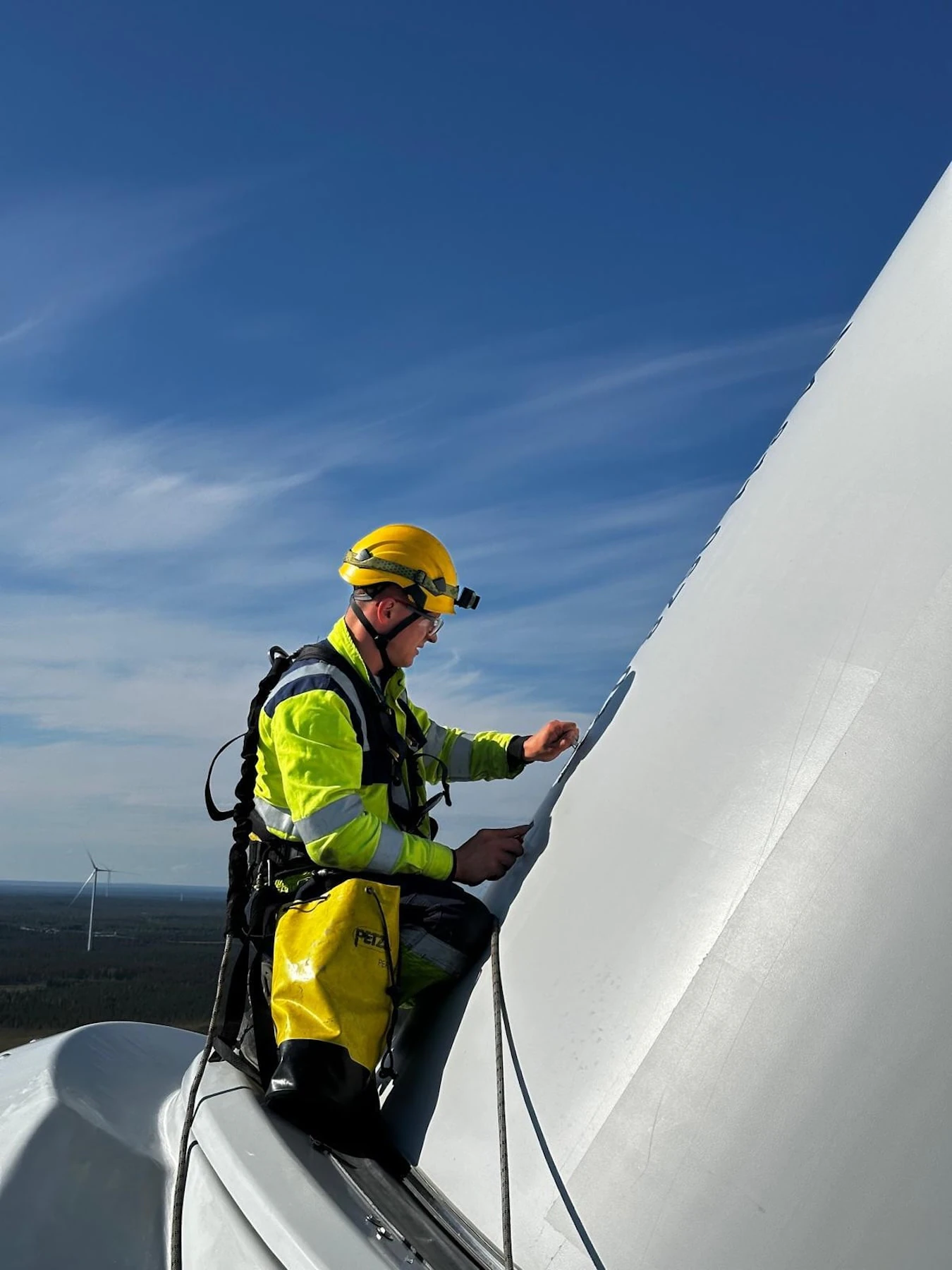
On a wind turbine, the rope access limit is only one of several. The turbine manufacturer sets limits for the machine, such as when the rotor may be locked or the service crane used, and the owner or operator adds site rules. Current manufacturer service manuals are rarely public, so the table uses the published examples we could verify. Do not apply them to your turbine without checking its own documents.
| Source | Limit | What it applies to |
|---|---|---|
| Spanish Wind Energy Association (AEE) rope work guide, 2014 | 12 m/s | Maximum wind speed for rope work on wind turbines as a rule, with the rotor locked in the position of least resistance; above 12 m/s all work halts and the site is left |
| Vestas safety regulations for the V90-3.0MW and V100-2.75MW, item 960314, 2006 | 23 m/s | The rotor locking system must not be set or used above this wind speed |
| Same Vestas document | 15 m/s | Blades may not be pitched while the rotor is locked, except below 15 m/s and one blade at a time |
| Same Vestas document | 15 m/s (10-minute mean) | No external operation of the internal service crane above this wind speed |
| IPAF wind rating guidance | 12.5 m/s | Typical maximum wind rating of an outdoor-rated MEWP |
| CompositesWorld, 2011, quoting a US blade repair firm | 10–15 m/s | Range of wind limits for blade repair work, with crews working up to the limits set by owners |
Two lessons follow. First, the turbine limits in the Vestas example are machine limits. A rotor lock rated to 23 m/s does not mean people can work on ropes at 23 m/s. Second, the binding limit is always the lowest one that applies: the rope access method statement, the manufacturer's procedure for the task, the owner's site rules and any equipment limit such as a platform or hoist rating. Our guide to rope access techniques in the wind energy sector explains how rotor locking, rigging and rescue fit together on a turbine.
Gusts versus mean wind
Forecasts and most wind limits quote a mean speed, usually over ten minutes. Gusts are what move a technician on a rope. Annex O is explicit about this (O.2.1.8): it is very important to take predicted gust speeds into account when deciding whether work should go ahead or continue. Where gust speeds are not known, it says the approximation that gust speed equals twice the mean speed may be used as a general guide for heights up to 35 m.
The physics explains why. Annex O notes that twice the wind speed means four times the pressure. A gust that doubles the wind speed quadruples the load pushing a suspended technician sideways, towards a tower or blade edge. High and gusting winds can blow a technician into a structure (O.2.1.7), push slack through the back-up device (O.2.3.1) and lift loose rope ends into machinery.
A good method statement therefore sets two triggers: a mean wind speed and a gust speed. For example, work may stop at whichever comes first of the agreed mean limit or a gust reading above a stated value. Both numbers come from the risk assessment, not from this article.
Hub height versus ground measurements
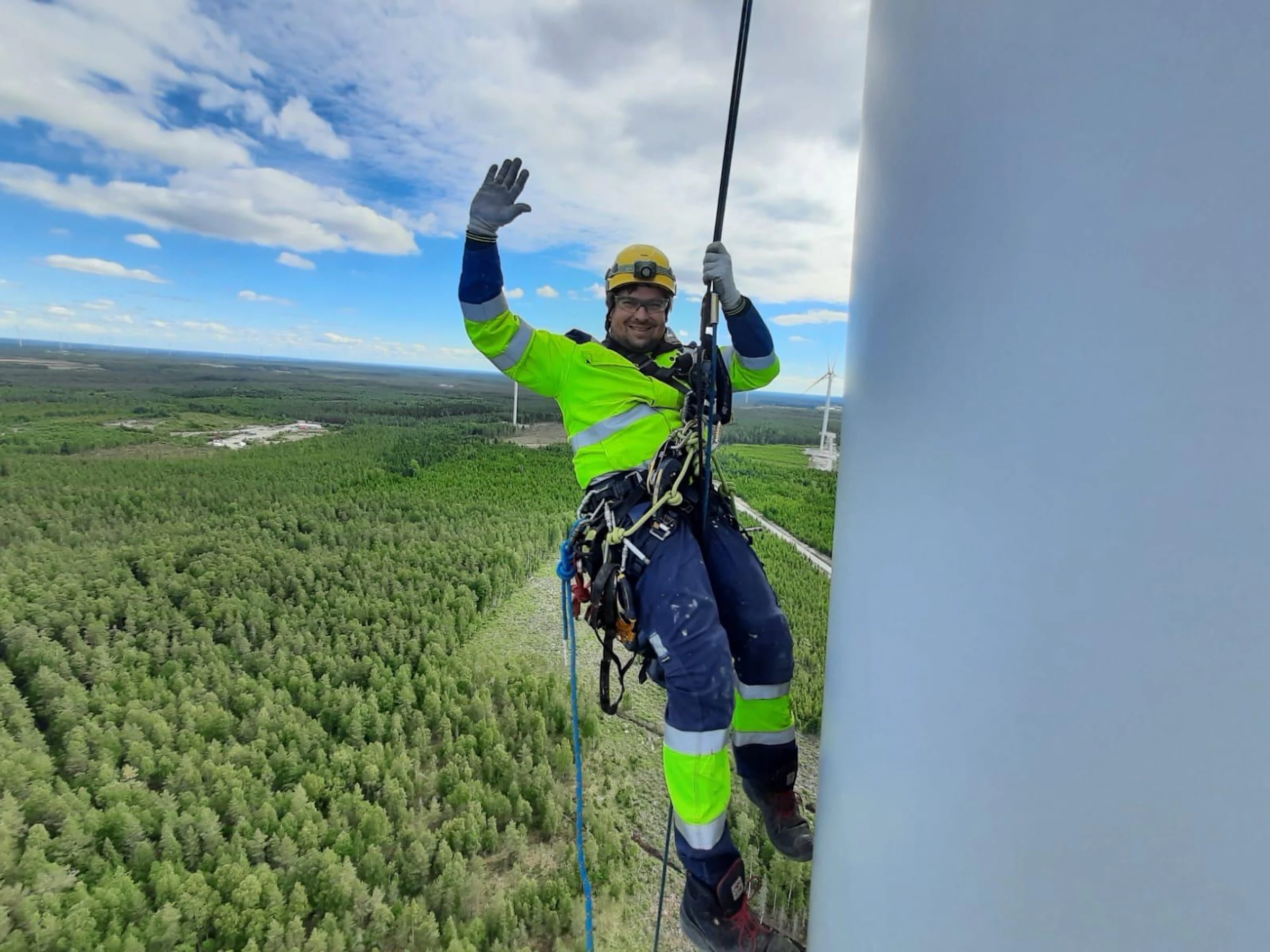
Wind normally increases with height, so a reading taken in the car park says little about conditions at the nacelle. Annex O makes three points that matter on turbines:
- The Beaufort scale is based on a ten-minute mean measured 10 m above the ground. At 2 m, the wind is likely to be 30% to 50% lower than the figures quoted (O.2.1.12).
- Even when the wind is acceptable lower down, it is likely to be windier higher up, and local features can funnel and speed it up (O.2.1.9).
- Weather forecasts should be checked before the task and updated regularly, and local knowledge can help (O.2.2.1).
IPAF's wind rating guidance makes the same point for powered access: a MEWP's wind rating is measured at the platform, the wind may be stronger at height than at ground level, and a hand-held anemometer should be used at the work platform. A turbine nacelle is many times higher than the 10 m forecast reference, so a forecast that looks workable can be outside the limit at the work position.
In practice, the method statement should say which reading counts: the turbine's own nacelle wind data from the control system, a hand-held anemometer at the work position, or a hub-height forecast. It should also say who reads it, how often, and what happens if the instruments disagree. The cautious rule is to use the highest relevant reading.
Lightning
Wind turbines are tall, exposed structures, and lightning is a direct threat to anyone on or in them. Our article on lightning strikes on wind turbines covers the damage side. For people, the issue is time: getting off ropes, de-rigging enough to leave safely and descending the tower all take longer than most storms give.
The Annex O text we reviewed does not set a lightning distance, so the rule comes from the site. One published description of wind farm practice, a paper by Don Leick of Telvent DTN (around 2010, describing US operators), gives typical procedures:
- An advisory range of 50 miles (about 80 km), at which crews are alerted and prepare to stop.
- A warning range of 30 miles (about 48 km), at which work in turbines stops and crews come down.
- An all-clear when there has been no lightning within 50 miles for 15 minutes.
- Descent from a turbine can take up to 20 minutes, which is why the warning distance is large.
European sites use their own distances and lightning detection services, so follow the site rule. For rope access, plan the evacuation time from the worst work position, including the time to make a casualty safe, not just the time to climb down.
Icing, cold and temperature
Cold changes both the limit and the length of time people can work. Annex O section O.3 uses the US National Weather Service wind chill chart. Its example: at −17 °C with a 24 km/h wind, the wind chill temperature is −28 °C and exposed skin can freeze in 30 minutes. Wind therefore lowers the safe working time well before it reaches any balance limit.
The AEE guide proposes cold limits for wind turbine work. Below about −23 °C work on the outside of the nacelle is limited, and at −31.1 °C all exterior work stops. It also caps uninterrupted suspension at four hours in any conditions.
Ice adds two more hazards: ice falling or being thrown from the rotor and nacelle onto people below, and ropes, connectors and devices that stiffen or ice up. Battery tools and radios also lose capacity in the cold. Our guide to wind turbine icing problems covers ice throw distances, winter access and the temperature limits for blade repair materials.
Heat is the opposite problem. Annex O covers hot conditions and UV, and the AEE guide uses heat stress screening criteria to set work and rest cycles. Climbing a tower and working in a closed nacelle in summer can be harder than the rope work itself.
How limits are written into method statements and rescue plans
The ICOP lists adverse weather among the hazards a risk assessment must identify (Part 2, 2.2.4.3) and says the documents should be reviewed during the work as conditions change, such as the weather (2.2.4.5). Annex O adds a list of points for windy conditions: communications, regular monitoring of wind speed and variability, whether access, egress and rescue are affected, ways to limit swing such as short drops, re-anchors or lateral restraint, and the effect on the technicians' well-being (O.2.2.4).
A clear weather section in a rope access method statement usually covers:
- The mean wind limit and the gust limit for this task, and the source of each.
- Where and how wind is measured, and how often readings are recorded.
- Any lower limits from the turbine manufacturer, the site or equipment such as hoists or platforms.
- Lightning, rain, visibility, ice and temperature triggers, with the site's lightning distances.
- Work and rest periods for cold, wind chill or heat.
- Who decides to stop and resume, and how the decision is recorded.
- How long it takes to get everyone off the ropes and down, from the worst work position.
The rescue plan must work in the same conditions as the work. IRATA requires every safety method statement to include a rescue plan, and its Annex R on rescue and evacuation planning (October 2024) gives a structured way to build one. A rescue that needs a long haul or a traverse in a strong crosswind may be impossible near the top of the working limit. If so, the working limit has to come down, or the rescue method has to change. Our article on how safe rope access is shows why planning, supervision and rescue matter more than the rope itself.
Offshore turbines add sea state
Offshore, wind limits for the rope work are only part of the picture. Technicians must first transfer from a vessel or by helicopter, and the transfer has its own wind, wave and visibility limits. The work window is the time between a safe transfer out and a safe transfer back, minus travel. IRATA's Annex S on working over water (November 2024) adds planning for a fall into water. Our guide to CTV, SOV and walk-to-work access explains how those transfer limits shape offshore weather windows.
How we handle weather limits at Gridinta
As an IRATA Full Operator member, Gridinta plans each job to the ICOP: weather limits are written into the risk assessment and method statement, checked against the owner's and manufacturer's rules, and enforced on site by the Level 3 supervisor, with every technician able to stop work. Weather limits also affect cost and scheduling, which we cover in our guide to rope access rates and what drives the quote. If you are planning blade, tower or nacelle work, our rope access services page is the place to start.