
What a Wind Turbine Service Lift Inspection Covers, Who Does It and How Often
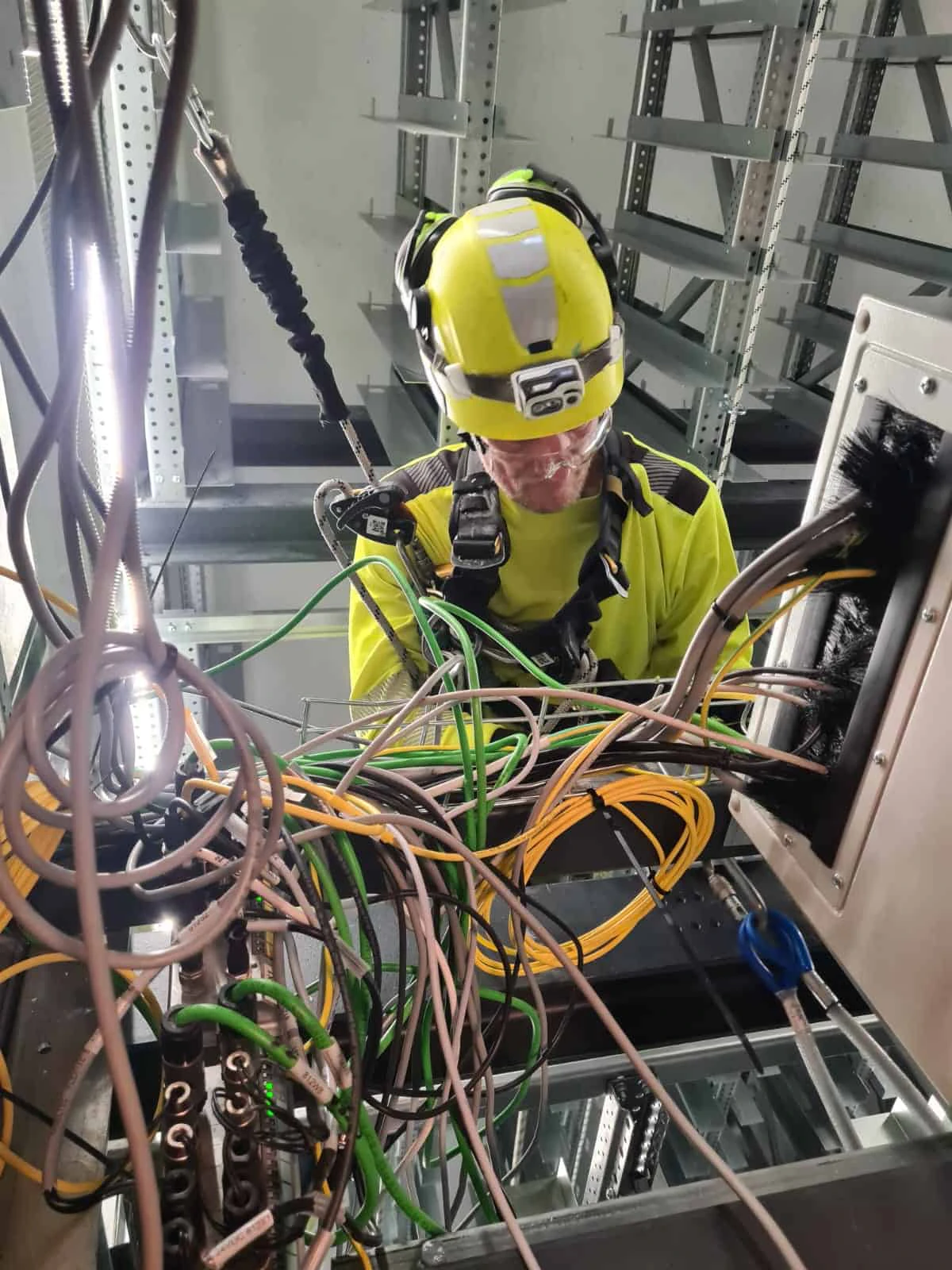
A wind turbine service lift inspection is a structured check that the lift inside the tower can still carry people safely. An examiner looks at the brakes, the overspeed safety gear, the wire ropes or rack, the guides, the controls, the emergency descent function and the landing gates. The examiner then writes a report that says whether the lift may stay in use. Who carries out that examination, and how often, depends on the country. This guide explains the lift types, the rules in Great Britain and Germany, what is checked, which documents to keep and what recent safety alerts mean for owners.
As of 18 October 2026. Rules and alerts change. Check the linked sources and your national regulator before relying on any interval in this guide.
Is there a lift in a wind turbine?
Yes, in many modern utility-scale turbines. Wind turbines do have elevators, usually called service lifts or tower lifts. A small car runs up the inside of the tower and stops at fixed landing platforms, so technicians and tools reach the top without a long ladder climb. The lift serves the tower's working levels and normally runs alongside the fixed ladder, which remains the alternative route.
Not every turbine has a lift. Older and smaller turbines are often climbed by ladder only. Lift maker Avanti, part of Alimak Group, markets its climb assistance system for turbines of average height and for older turbines without lift systems. So the honest answer to whether there is a lift in a wind turbine is: usually in newer, taller machines, but check the turbine model.
Service lift and climb-assist types
The European standard for turbine lifts, EN 81-44:2024, covers permanently installed lifting appliances that are guided, travel vertically or within 15 degrees of vertical, and are driven by rack and pinion or by rope traction. It limits rated speed to 0.7 m/s and covers operation between -25 °C and +55 °C. Climb assists and ladders are different equipment and are not lifts.
| Type | How it works | Inspection focus |
|---|---|---|
| Rope traction service lift | A traction hoist moves the car along a suspension wire rope, with a separate safety rope for the safety device | Hoist brake, safety device, suspension and safety ropes, guide wires, controls, landing gates |
| Rack and pinion lift | A motor drives a pinion along a rack fixed to a mast in the tower | Brakes, safety gear, rack and pinion wear, mast fixings, controls, landing gates |
| Climb assist | A motorised endless rope pulls the climber up the ladder; Avanti's system takes 35 to 45 kg of the climber's weight | Drive unit, rope, manufacturer checks; always used with ladder fall protection |
| Ladder with fall arrest | A fixed ladder with a guided rail or lifeline and a fall arrester on the harness | Ladder fixings, rail or lifeline, fall arrester, alignment with platforms and the lift |
Avanti states that its climb assistance must be used together with fall protection. A climb assist reduces effort; it does not replace the fall-arrest system. Treat it as separate equipment with its own manufacturer inspection requirements.
EN 81-44 excludes some designs, including hydraulic and pneumatic drive units and lifts in floating wind turbines. It also does not apply to lifting appliances manufactured before its publication. Many installed lifts were therefore built before any wind-specific European lift standard existed.
Which rules apply to wind turbine service lifts?
Three layers of rules usually meet in one tower. The design layer covers how the lift was built and placed on the market: the Machinery Directive and, for new designs, EN 81-44. From 20 January 2027 the EU Machinery Regulation replaces the directive; our article on when the EU Machinery Regulation makes you the manufacturer explains how retrofits can trigger new duties.
The use layer covers how the operator keeps equipment safe in service. In the EU, Directive 2009/104/EC on the use of work equipment requires inspection and testing by competent persons: initial, after assembly, periodic and special, with results recorded. Each member state turns this into national law, and that is where inspection intervals and inspector qualifications are set. The third layer is the manufacturer's maintenance manual and any safety notices it issues.
Who inspects a wind turbine service lift, and how often?
The table compares two well-documented regimes. Other countries set their own rules, so confirm them with the national regulator or an accredited inspection body.
| Jurisdiction | Legal basis | Who examines | Interval |
|---|---|---|---|
| Great Britain | LOLER 1998, regulation 9 | A competent person | At least every 6 months for equipment lifting people, or under a written examination scheme, and after exceptional circumstances |
| Germany | BetrSichV Annex 2, Section 2; TRBS 1201 Part 4 and TRBS 3121, Annex 5 | An approved inspection body (ZÜS) | Before first use and after relevant changes; main examination at most every 2 years, with an intermediate examination midway |
| EU baseline | Directive 2009/104/EC | Competent persons as defined in national law | Periodic, set by each member state |
| All | Manufacturer manual and EN 81-44 (new lifts) | Trained maintenance staff | As the manufacturer specifies, plus daily or pre-use checks |
Great Britain: LOLER thorough examination
Under regulation 9(3) of LOLER, lifting equipment for lifting persons that is exposed to deterioration must be thoroughly examined at least every 6 months, or in line with an examination scheme drawn up by a competent person. An extra examination is needed each time exceptional circumstances could have affected its safety. HSE's guidance on lifting equipment used for lifting people repeats the six-monthly interval. A turbine service lift carries people, so the six-month interval is the starting point unless a scheme sets something else.
If the examiner finds a dangerous defect, regulation 10 requires the employer to be told at once. Where there is an existing or imminent risk of serious personal injury, a copy of the report must also go to the enforcing authority. The lift must not be used until the defect is put right.
Germany: BetrSichV and the ZÜS
German technical rules treat lifts in wind turbines as lift installations (Aufzugsanlagen) under Annex 2, Section 2 of the Betriebssicherheitsverordnung. An approved inspection body, a ZÜS (zugelassene Überwachungsstelle), inspects the lift before first use and after modifications that require inspection. Periodic main examinations follow at an interval the employer sets, which may not exceed two years. An intermediate examination takes place midway between two main examinations.
Two technical rules now carry annexes written for wind turbines. TRBS 3121, Annex 5 sets operating requirements, including a rescue concept and a daily visual and function check before use. TRBS 1201 Part 4, Annex 5 describes what the ZÜS checks during the examination.
What is checked during a service lift inspection
The exact list comes from the lift manufacturer and the examiner. The German TRBS 1201 Part 4, Annex 5 is a useful published example, and the HSE bulletin adds the gate and control points. The table groups the main items.
| Component | What is checked | Why it matters |
|---|---|---|
| Brakes | Operating brake and traction under static and dynamic load; redundant brake circuits or hoists tested one by one | The brake holds the car and its load at every stop |
| Overspeed safety gear | Mounting and triggering devices of the safety device; holding capacity with rated load | Stops the car if it overspeeds or a suspension element fails |
| Wire ropes or rack | Suspension and safety ropes, end connections, pre-tension and rope guidance; rack and pinion wear | Worn or damaged ropes and racks are a direct failure path |
| Guides | Car guides and guide wires or rails along the travel path | Keeps the car on its path and clear of tower fittings |
| Controls | Operating modes, emergency stop, final limit switches, slack-rope switches, interlocks and control position | Prevents unintended movement and trapping |
| Emergency descent | Lowering without drive power; rescue concept, equipment and communication | Gets people down safely after a power or drive failure |
| Landing gates and guarding | Gate interlocks, guarding, crush and shear protection at access points, reach to moving parts | The HSE trapped-hand incident happened at this interface |
| Documents | Declaration of conformity, manual, wiring diagrams, emergency plan and previous reports | Shows the lift matches its design and maintenance history |
Brakes and overspeed safety gear
Brakes and safety gear are the two most safety-critical systems. TRBS 1201 Part 4, Annex 5 lists load tests of the operating brake and traction, separate tests of redundant brake circuits, and checks of the triggering devices and holding capacity of the safety device. Brake pad material is now part of the conversation too, as the Australian alerts below show.
Ropes, rack and guides
On a rope traction lift, the examiner checks the suspension and safety ropes, their end connections and pre-tension, and how the ropes are guided along the travel path. On a rack and pinion lift, the rack, pinion and mast fixings take that role. Guide wires or rails keep the car aligned with the platforms and clear of cables and ladders.
Controls, emergency descent and landing gates
Controls are checked in every operating mode, together with the emergency stop, final limit switches, slack-rope switches and interlocks. The emergency descent function must lower the car without drive power, and the rescue concept must match the lift design. At landings, gates and guarding must stop access to the moving car. The HSE bulletin ED01-2024 found external controls placed too close to the danger zone, contrary to the reach distances in BS EN ISO 13857.
Daily checks by lift users
Between examinations, users carry out short pre-use checks. In Germany, TRBS 3121, Annex 5 requires a daily visual and function check before use, immediate reporting of defects, and taking the lift out of service if a defect endangers people. Documenting these checks is recommended.
Documentation an owner should keep
A complete lift file makes each examination faster and supports decisions on repair, retrofit and end-of-warranty claims. Keep:
- the EU declaration of conformity, operating instructions, technical documents and wiring diagrams;
- the emergency plan and rescue concept, including rescue equipment locations and communication arrangements;
- maintenance records and the manufacturer's maintenance schedule;
- every examination report; under LOLER Schedule 1 a GB report lists defects, required repairs, the latest date for the next examination and the examiner's details;
- manufacturer safety notices and evidence of how each was closed;
- repair and retrofit records with photographs, completed actions and validation results.
If your turbines are close to the end of the warranty period, add the lift file to the end-of-warranty inspection review. Our onshore inspection and maintenance checklist already lists the service lift or hoist among the tower items to verify.
Common findings and safety alerts
Public sources point to a few recurring problem areas. These are examples from alerts and project evidence, not fleet statistics.
- Gates, guarding and control positions. HSE described a technician's hand trapped between fixed and moving parts while using external controls. Its bulletin also noted that the lack of a defined industry standard had led to inconsistent safeguards.
- Access alignment and worn components. In our JASO service lift case study, the scope across 41 turbines combined lift repair and retrofit with ladder alignment, because misalignment and worn parts make tower access slower and less safe.
- Brake material. Australian regulators found asbestos in brake pads used in wind turbine lifts and hoists, described below.
Asbestos in turbine lift brake pads: Australian alerts
On 19 December 2025, SafeWork NSW in Australia published an alert on asbestos in brake pads used in wind turbines. It says such pads are used in service lift motors, material hoists, and yaw and rotor brakes. The turbines and pads were imported from overseas, and asbestos was found across more than one manufacturer. Operators were told to assume that all brake pads, including spare parts, contain asbestos until proven otherwise, and to stop access, maintenance and servicing on lifts with brake pads in operation until a competent person had inspected them.
Workplace Health and Safety Queensland issued its own alert on brake pads used in windfarms on 23 January 2026. These are Australian alerts. They do not state that turbine lifts in Europe are affected. Owners in other markets can still ask their lift manufacturer for a material declaration for brake pads and spare parts, and should follow any manufacturer safety notice.
After the inspection: repair and retrofit
An examination report often ends with defects to repair or modifications to make before the next interval. That work is separate from the examination itself. The examiner the operator appoints decides whether the lift is safe to use; a maintenance or repair contractor carries out the work in between.
Gridinta carries out wind turbine service lift repair and retrofit on operating turbines. Our published work covers JASO elevator systems on 41 turbines, 25 in Finland and 16 in Latvia, with ladder alignment and, in Finland, validation inspections. We are not a statutory inspection body; we document the work so your examiner can complete the next examination.