
What Every Rope Access Rescue Plan Needs, and How Clients Can Check It
A rope access rescue plan is the written, site-specific method the team on site will use to free an injured or incapacitated technician from the ropes and hand them to medical care. EU law requires rope work to be planned so a worker “can be rescued immediately”, and IRATA requires a rescue plan in every safety method statement.
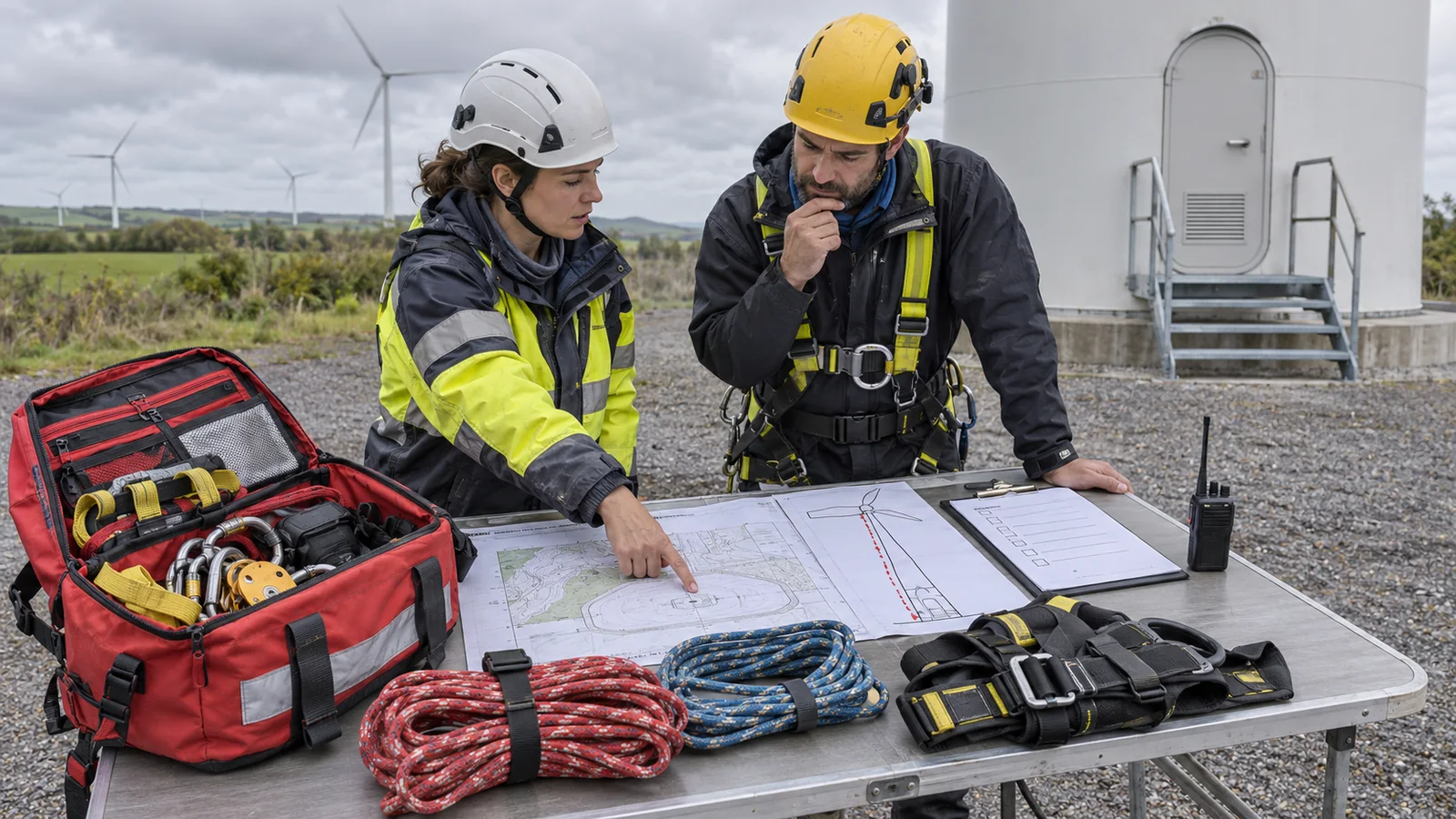
The eight items below serve two readers: the Level 3 supervisor drafting a plan and the client safety manager deciding whether to accept one. Any work at height rescue plan follows the same logic, but rope access adds a problem a MEWP plan rarely meets: the casualty is already hanging in a harness, often far from a platform. When you scope industrial rope access services, the rescue plan should arrive with the method statement, not after mobilisation.
Is a rescue plan a legal requirement for rope access?
Yes. In the EU it follows from the Work Equipment and Framework Directives, in Great Britain from the Work at Height Regulations, and IRATA requires it of its member companies. The table shows the provisions a plan should trace back to, as of November 2026. Each EU country transposes the directives into national law, so also check the rules where the work takes place.
Scroll horizontally to see all table columns.
| Source | Provision | What it says | What the plan must show |
|---|---|---|---|
| Directive 2009/104/EC (work equipment) | Annex II, point 4.4(e) | Rope work “must be properly planned and supervised, so that a worker can be rescued immediately in an emergency”. | A method the team on site can start at once, without waiting for outside help. |
| Directive 2009/104/EC | Annex II, point 4.4(f) | Workers receive training specific to the operations envisaged, “in particular rescue procedures”. | Rescue training and drill records for the named team. |
| Directive 89/391/EEC (framework) | Article 8(1)–(2) | Employers arrange first aid and evacuation, contacts with external rescue services, and designated, trained workers. | Named rescuers, a first aider and the route to outside services. |
| Directive 89/391/EEC | Article 6(4) | Employers sharing a workplace cooperate, coordinate and inform one another. | How the contractor’s plan fits the client’s emergency arrangements. |
| IRATA ICOP | 1.4.3.11 and 2.2.5.2 | Every safety method statement includes a rescue plan specific to the job. | The plan inside the method statement, not a generic company procedure. |
| ISO 22846-1:2003 and ISO 22846-2:2012 | Parts 1 and 2 | International principles and code of practice for rope access; both confirmed by ISO in February 2024. | Alignment where a client’s specification cites ISO rather than IRATA. |
| EN 50308:2004 (wind turbines) | 4.2.2 | An alternative escape route from the nacelle, an anchorage near the emergency hatch and provision to evacuate an injured person from any work area. | Use of the turbine’s own hatches, anchors and descent provisions. |
| UK Work at Height Regulations 2005 | Regulation 4(2) | Planning of work at height “includes planning for emergencies and rescue”. | On sites in Great Britain, a rescue plan for every task at height. |
1. Named people who write, approve and run the plan
The rope access contractor writes the plan, because the team that rigs the ropes is the team that will rescue from them. Under the IRATA scheme the Level 3 rope access safety supervisor must be able to organise and carry out a workmate rescue suited to that worksite (ICOP 1.4.2.3.4), and the Level 3 and their company both confirm before work starts that the rescue procedures are adequate and the team is briefed (ICOP 2.11.6.6). See what IRATA Level 3 supervisors do on site for the rest of that role.
The client or site operator accepts the plan and connects it to the site’s own emergency response. Submitted with the method statement and permit request, the plan should name:
- Author and approver: the Level 3 who wrote it and the person in the contractor’s company who approved it, with a dated revision for this job.
- Rescue leader: ICOP 2.11.11.5 asks for a clearly defined leader. Name a deputy for the day the leader is the casualty.
- First aider: someone competent in first aid at the worksite at all times, with a first aid kit (ICOP 2.11.11.6).
- Site interface: the control room, site manager or marine coordinator who receives the alarm and runs the wider response.
Why the fire service cannot be the rescue plan
Public emergency services are the next link in the chain, not the rescue method. HSE’s guidance for Great Britain says rescue arrangements “should not rely on the fire brigade as this may result in a delay which may be critical”. On a rural wind farm, a tank farm or an offshore turbine, travel time alone can exceed the minutes that matter for a technician hanging motionless (item 5). The rope access standards draw the same line: ISO 22846-1 leaves line rescue by emergency services outside its scope, and the IRATA code expects every work team to be self-supportive with respect to rescue (ICOP 2.11.6.1). For outside responders, the plan’s job is to get them to the casualty: how they are contacted and guided to the right position on site (ICOP 2.11.4).
2. A credible scenario for every work position
A plan that says “in an emergency the casualty will be lowered to the ground” has not been written for a site. ICOP 2.2.4.6 asks the risk assessment to consider foreseeable emergency scenarios and how each rescue would be carried out. IRATA’s Annex R on rescue and evacuation planning, released in October 2024, walks through the plan step by step, from arrival on site to communicating with emergency services, with an adaptable template; it deliberately does not teach the physical rescue. For each work position on the job, the plan should name:
- the casualty’s likely position: on the working line, caught at a re-anchor or deviation, inside a confined section, or at a platform edge;
- the credible causes: a falling-object injury, a medical event such as collapse or heat illness, entanglement, a jammed or damaged device, or fire;
- the condition to plan for: a conscious casualty who can help, and an unconscious, motionless one, which is the case that drives the timing;
- the safe place the casualty will be moved to, and the route from there to an ambulance or vessel.
The rigging has to allow for this from the start: ICOP 2.11.4 asks for systems configured so technicians are likely to be able to rescue themselves, a workmate retrieval can happen in a timely fashion, and nobody works alone. Every changeover or re-anchor that helps the work can complicate a rescue; the overview of rope access techniques used on wind turbines shows where those transitions occur.
3. A rescue method matched to the structure
The method follows the structure. These five situations are where a usable plan most often differs from a template.
Tower exterior and blade surface
For blade and tower work the ropes are usually anchored at the nacelle or hub, so the commonest rescue is a direct lower to the ground or a platform, the one case where IRATA lets a team of two be considered (item 6). The plan should confirm that the rescue rope reaches the landing point from the rescue anchors, that the landing area is clear and reachable by vehicle, and how the casualty is kept off the tower or blade on the way down. Rigging for rescue, with the lines on releasable anchors, lets the team lower or raise a casualty without a rescuer first travelling to them (ICOP definitions and 2.11.11.3).
Nacelle roof, hub and spinner
In the hub and spinner the casualty may be inside a confined, locked and isolated rotating component, so the plan must say how they are moved into the nacelle and which exit follows. EN 50308:2004 requires an alternative escape route from the nacelle, an extra hatch to the outside that opens from both sides, an anchorage point near the emergency hatch, and provision to evacuate an injured person from any area occupied for work (clause 4.2.2). Name that hatch, anchor and descent device in the plan, check them against the turbine’s manual on site, and confirm the stretcher fits every opening on the route: the standard allows wall hatches as small as 0.4 m by 0.6 m (clause 4.2.1).
Inside the blade
Inside a blade the space narrows towards the tip and the only way out is back through the root and hub, so the casualty may need to be packaged and moved horizontally before any lower begins. Where the site treats the blade or hub as a confined space, the plan must also cover the entry permit, a standby person at the root, atmosphere monitoring when resins or solvents are in use, and radio contact from the furthest working point, tested in the drill. In Great Britain the Confined Spaces Regulations 1997 forbid entry until suitable rescue arrangements are prepared (regulation 5).
Tanks, silos and industrial structures
On a tank shell or process structure the rescue is usually a lower to grade, but the plan must fit the plant: permits, isolations, hot surfaces and the site’s own emergency team. Inside a tank or vessel, confined-space rules apply, and the IRATA code asks for a more capable team where the work area could cause poisoning or asphyxiation (ICOP 2.11.6.7). The code also asks for clear instructions on site emergencies at places such as refineries (ICOP 2.11.11.4): agree with the control room what the rope team does when a site-wide alarm sounds, so a muster never leaves a technician on the ropes unsupported.
Offshore transition pieces and towers
The sea is not a safe place, so an offshore plan normally brings the casualty up to the transition piece platform or into the turbine, then to a vessel. It must say who requests the vessel, how long it takes to arrive and what happens if sea state rules out a transfer. Work over water needs rescue equipment and arrangements for the prompt rescue of anyone in danger of drowning (ICOP 2.11.6.8); IRATA’s Annex S on working over water (November 2024) adds guidance on locating a casualty in the water and overboard procedures. Communication must reach the vessel and control room as well as the team (ICOP 2.11.9.1). Our offshore rope access safety practices guide covers the permit and handover chain.
4. Rescue kit that is ready and rated for the planned load
The rescue kit must remain available for the planned method throughout the job. A working system configured for rescue can form part of that method; additional equipment must be ready at the work position. ICOP 2.11.11.3 requires rescue equipment to be present and ready for immediate deployment at the worksite, sufficient for a rescue from any situation on that site; the preferred arrangement is the team’s own system rigged for rescue. Depending on the risk assessment, that can mean a fully pre-rigged rescue system (ICOP 2.11.4). The plan should list:
- What and where: each rescue item, where it is kept at the work position, and who checks it at the start of the shift.
- Rescue-load ratings: verify the permitted mass and configuration of every loaded component against the manufacturer’s instructions. Include the casualty, rescuer and any stretcher or equipment when the method loads them together. A device permitted for one person may need a different rope, friction arrangement or procedure for rescue use.
- Rope length: enough rope at the rescue anchors to reach the planned safe place, with protection for any new edge on the rescue path.
- Casualty handling: stretcher or casualty bag, attachments for lifting and lowering, and any cutting tool the method relies on.
- Compatibility: each item checked against the others and the manufacturer’s instructions, because rescue loads can be significantly higher than a device’s maximum rated load (ICOP 2.7.5.3).
The rope access equipment list shows how rescue kit fits the wider system. Powered ascenders need their own decision, because the ICOP does not cover them (note to 2.7.6). If the plan uses one, such as the Smart Spider powered ascenders Gridinta supplies, to raise a casualty or rescuer, confirm in the manufacturer’s instructions that the rescue load and set-up are permitted before the plan is approved.
5. A target time in minutes, and care for suspension intolerance
The cited EU provision and IRATA guidance do not define a universal safe suspension time. The EU wording is “immediately”, and the medical evidence explains why. A technician hanging motionless in a harness, because they are unconscious, injured or exhausted, can develop suspension intolerance: blood pools in the legs, which can lead to fainting and, if it continues unchecked, death (ICOP Annex G).
HSE research report RR708 (2009) reviewed the evidence. Motionless head-up suspension led to pre-syncope, the warning stage before fainting, in most healthy subjects within an hour and in a fifth of them within 10 minutes. The report also cites a later NIOSH study estimating that, for no more than 5% of workers to develop symptoms, rescue would have to happen within 7 minutes with a chest attachment point and 11 minutes with a back attachment point. That study looked at chest and back attachments rather than a rope access sit harness, but the lesson carries over: plan in minutes, not in the time an outside crew needs to arrive. The plan should state:
- a target time from alarm to casualty out of suspension, measured in a drill on this structure;
- how a conscious casualty waiting for rescue keeps their legs raised and moving, which may prolong tolerance where it is safe (RR708; ICOP G.2.3);
- first aid after rescue: call emergency medical services promptly and have the trained first aider assess responsiveness and breathing. If the casualty is unresponsive and not breathing normally, start CPR and use an AED as directed. Use the recovery position only when CPR is not indicated and trauma does not make that position inappropriate, following current first-aid guidance;
- hospital assessment for every casualty who has hung motionless in a harness, with medical staff told about the suspension (ICOP G.2.7).
6. People who can do the rescue, proven in drills
A plan is only as good as the people on shift that day. IRATA sets the minimum rope access team at two technicians, one of them a Level 3 competent to supervise rope access safety. A team of two should only be considered where either technician could rescue the other rapidly and unaided, such as by a direct lower to a safe place; otherwise three is the normal minimum unless other arrangements have been tried and tested (ICOP 2.11.6.2–2.11.6.4). Level 2 technicians are trained in more complex rigging and rescue; Level 3s need extensive knowledge of advanced rigging and rescue and a current first aid certificate (ICOP 2.5.2.1).
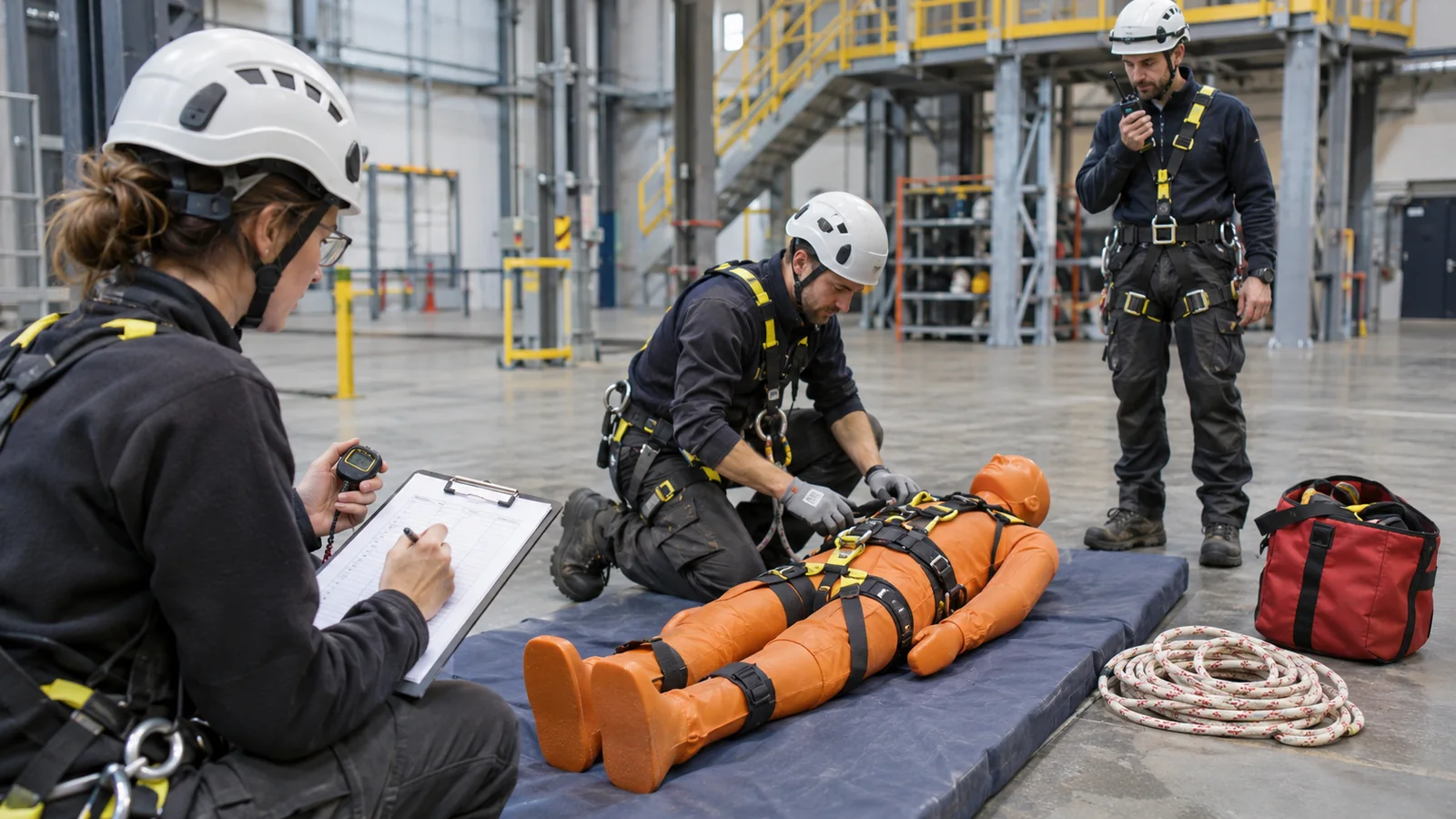
Rescue procedures should be practised at regular intervals and before work in situations unfamiliar to anyone in the team (ICOP 2.5.2.9). A drill on the actual structure, timed from alarm to casualty at the safe place, turns the target time into evidence and exposes missing kit before an emergency does. Record who took part, the scenario, the time achieved and what changed afterwards.
Wind turbine owners may also specify GWO Advanced Rescue Training. Version 6, effective from 10 March 2026, has two 12-hour initial modules, Hub, Spinner and Inside Blade Rescue (ART-H) and Nacelle, Tower and Basement Rescue (ART-N), each with a 7.5-hour refresher and a record valid for 24 months. Entry requires valid BST Working at Height, First Aid and Manual Handling records. The hub module trains technicians to decide the rescue and evacuation strategy, coordinate the handover of an injured person and assess single-rescuer options. ART records training outcomes; site planning and drills establish how the named team will carry out the rescue on this turbine. Gridinta’s training partner Novikontas delivers GWO training courses, including ART.
7. Alarm, communication and casualty handover
The plan should read as a sequence that starts with the alarm and ends when medical care takes over. Two tracks start at the same moment: the rope team begins the rescue, and someone outside the rope system calls site control and the emergency services.
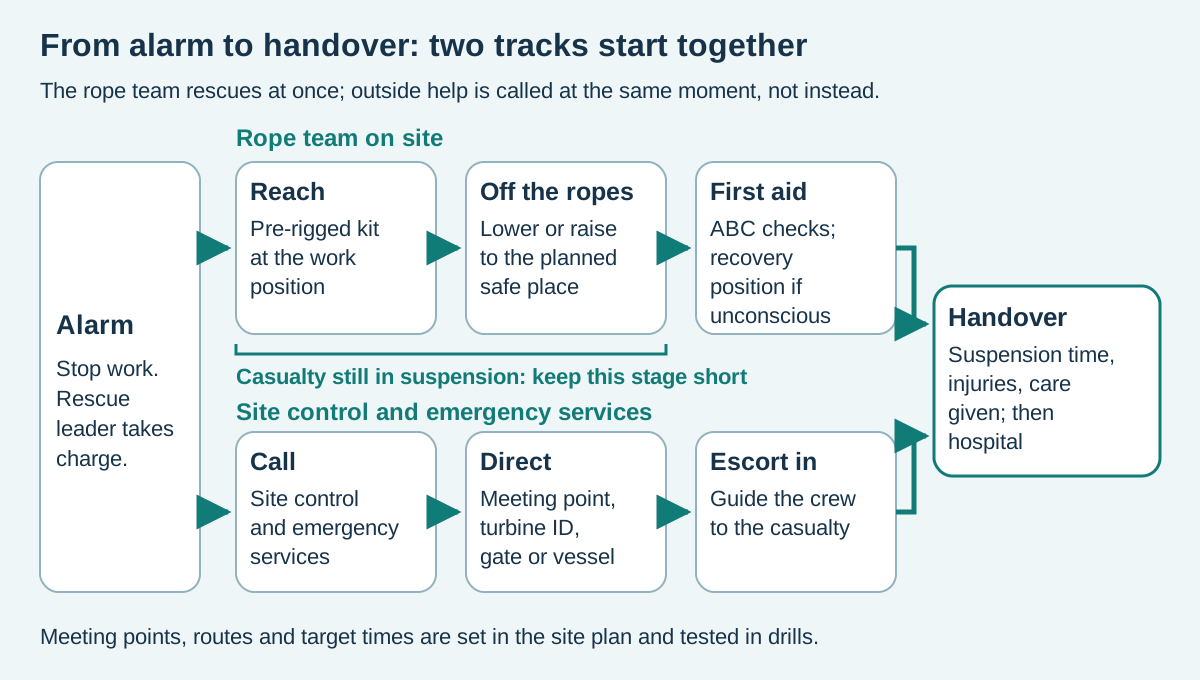
Communication is the link between the tracks. The ICOP asks for an efficient system between all technicians and, where necessary, third parties such as an offshore control room, agreed before work starts and effective for the whole time people are at work. Radios are recommended unless everyone stays within sight and earshot, and a signal to summon help if other methods fail should be agreed and rehearsed (ICOP 2.11.9). For the handover, the plan should give:
- the emergency number and the site control number, and who calls each;
- the meeting point, gate access or vessel arrangements, and the person who guides responders to the casualty (ICOP 2.11.4);
- the turbine or structure identifier and its coordinates, so responders go straight to the right location;
- what the handover covers: time of the incident, how long the casualty was suspended, injuries found and first aid given.
8. Weather, darkness and review triggers
A rescue has to work in every condition in which work is allowed. IRATA’s Annex O on environmental conditions asks for a rescue plan with emergency equipment in place or readily accessible (O.1.3), and whether wind affects access, egress and rescue (O.2.2.4). A haul or traverse that works in calm air may be impossible near the top of the wind limit; then the limit comes down or the method changes, as our article on rope access wind speed limits explains. If a shift can run into dusk, the plan also needs head torches, lighting at the landing point and a finish time that leaves daylight for a rescue.
IRATA asks for the worksite to be examined for feasible emergency scenarios at appropriate times, for example each day, at each change of job and when environmental conditions change (ICOP 2.11.11.1), and the daily pre-work briefing refers to the rescue plan (ICOP 2.11.7.2). Revise the plan itself, not only the briefing, when:
- the work moves to a new turbine model, structure or work position;
- the team, the Level 3 or the rescue kit changes;
- weather, sea state or daylight limits change;
- a drill misses its target time or exposes a gap;
- a near miss or incident occurs on this job or a similar one.
How to review a contractor’s rope access rescue plan
A client does not need to know how to rig a rescue to judge whether a plan is real. Ask the questions below and expect written answers before mobilisation. IRATA requires every safety method statement to include a rescue plan, so a member contractor should be able to share it with your HSE team; membership itself can be checked in IRATA’s directory, as described in our review of IRATA’s rope access safety data.
Scroll horizontally to see all table columns.
| Question | A usable answer | Warning sign |
|---|---|---|
| Who wrote and approved it? | Named Level 3 and company approver; dated revision for this job | Unsigned company procedure reused across sites |
| Which scenarios does it cover? | Each work position, with casualty location and condition | One line: “the casualty will be lowered to the ground” |
| Where does the casualty go? | A named safe place and route to the ambulance or vessel | “Await emergency services” |
| What kit, and where is it? | Listed items, rigged or staged at the work position, with ratings checked for the planned rescue load | Rescue kit kept in the van |
| How fast? | A target time achieved in a drill on this structure | No time, or a time never tested |
| Who does it? | Team size justified by the rescue method; named rescue leader and first aider | Two-person team for a rescue that needs a haul or traverse |
| How does help arrive? | Numbers, meeting point, coordinates and handover content | A phone number only |
| When is it reviewed? | Daily briefing plus listed revision triggers | No revision since the template was written |
Download the rescue plan review checklist (CSV) to record each answer, the evidence received and your decision, with the ICOP or legal reference for every line. For the wider contractor choice, including method statements and references, see how to choose a wind turbine maintenance company.
Rope access rescue plan questions from clients and supervisors
Who is responsible for a rope access rescue plan?
Can a rescue plan rely on calling the emergency services?
How long can someone hang in a harness before it becomes dangerous?
What does “rigged for rescue” mean in rope access?
How often should rope access teams practise rescues?
Does GWO Advanced Rescue Training replace the rescue plan?
How is a rope access rescue plan different from a MEWP or scaffold rescue plan?
What should a client receive before rope access work starts?
Sources
Sources checked on 11 November 2026:
- Directive 2009/104/EC on the use of work equipment (EUR-Lex), with Annex II point 4.4 quoted from the published EU text of Annex II
- Directive 89/391/EEC, Article 8 (first aid, fire-fighting and evacuation) and Article 6 (employers’ general obligations)
- IRATA International code of practice for industrial rope access (ICOP), Parts 1–3 including Annexes G and O
- IRATA: new ICOP Annex R on rescue and evacuation planning (25 October 2024)
- IRATA: ICOP Annex S on working over water (8 November 2024)
- HSE RR708, Evidence-based review of the current guidance on first aid measures for suspension trauma (2009)
- HSE construction work at height FAQ: rescue planning
- Work at Height Regulations 2005, regulation 4 and Confined Spaces Regulations 1997, regulation 5
- GWO Advanced Rescue Training Standard, Version 6
- EN 50308:2004, Wind turbines: protective measures (preview including clause 4.2)
- ISO 22846-1:2003 and ISO 22846-2:2012, rope access systems
- Resuscitation Council UK, First Aid Guidelines (2025)